


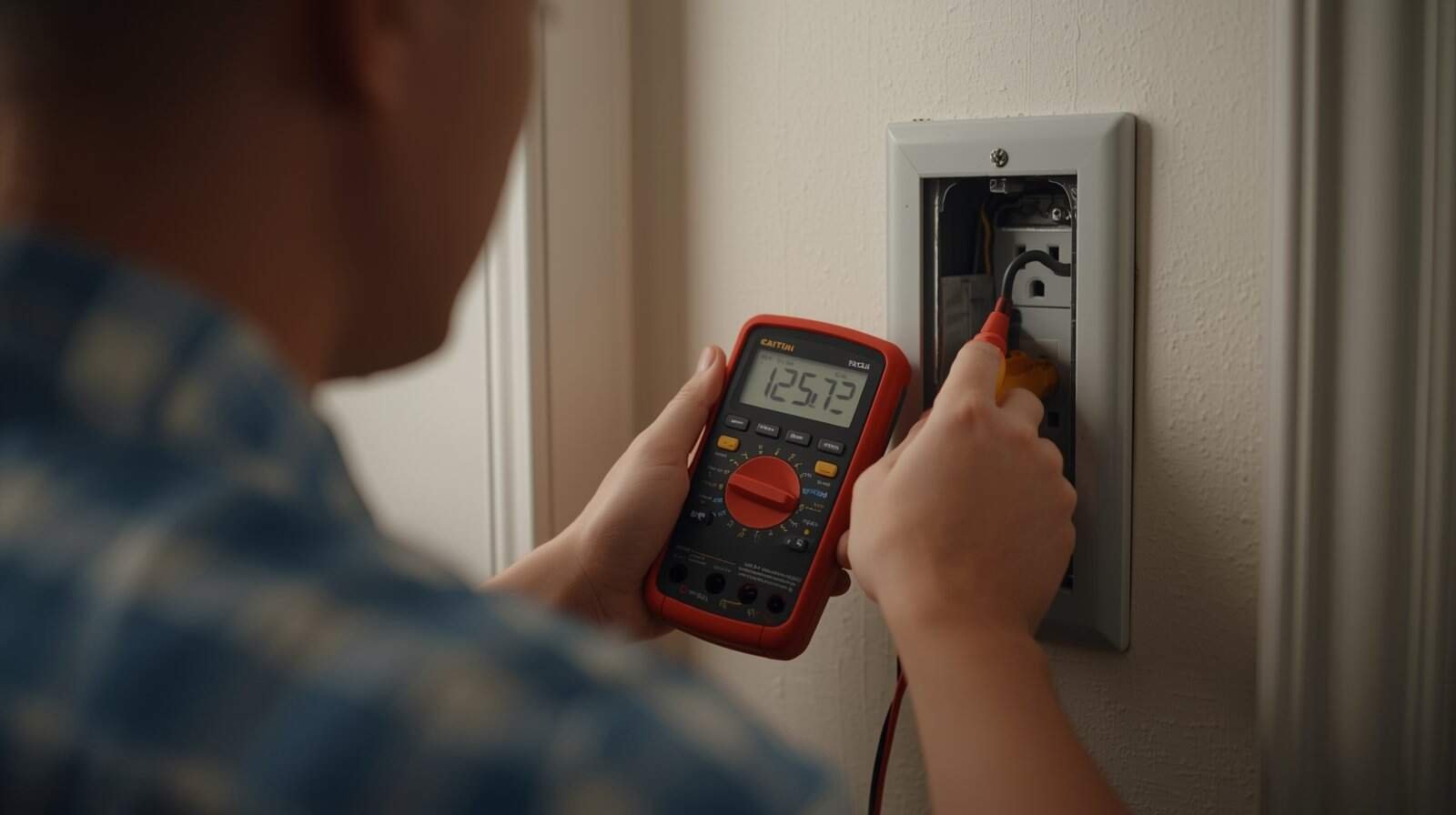
A multimeter can help a homeowner answer a few basic electrical questions, but it can also create a shock or short-circuit hazard if it is set up incorrectly or used around exposed energized parts. For beginners, the safest goal is verification, not repair: confirm whether voltage appears to be present at an accessible receptacle, check continuity only on equipment that is fully de-energized, and stop before removing electrical covers or probing inside panels.
The most important rule is to use the correct meter, the correct input jacks, and the correct measurement mode before the probes touch anything. Never measure resistance or continuity on an energized circuit, and do not use the current/amp setting on household wiring as a beginner test. If the test requires opening a breaker panel, junction box, appliance cabinet, transfer switch, or other protected electrical enclosure, it has moved beyond a basic homeowner check.
What a Multimeter Can Safely Help a Homeowner Check
Most digital multimeters can measure several electrical properties, but that does not mean every function is appropriate for a beginner. The safest homeowner uses are limited and deliberate.
| Measurement | Beginner use | Important limit |
|---|---|---|
| AC voltage | Limited checks at an intact, accessible receptacle when you know how to use the meter correctly | Do not remove covers or probe exposed household wiring |
| DC voltage | Batteries and other low-voltage sources within the meter’s rating | Confirm polarity, range, and equipment instructions |
| Continuity | Checking an unplugged cord, fuse, switch, or other isolated component when appropriate | Circuit must be fully de-energized |
| Resistance | Limited testing of isolated, de-energized components | Never use resistance mode on an energized circuit |
| Current / amps | Generally not a beginner household-wiring test | A meter placed incorrectly in current mode can create a dangerous short circuit |
A multimeter can tell you what it sees at the exact points being tested. It cannot tell you automatically why a breaker trips, whether hidden wiring is damaged, whether a connection is overheating behind a wall, or whether a circuit is safe to repair.
Choose a Meter and Test Leads Appropriate for the Job
Before using a multimeter on household electrical equipment, read the meter manual and check the safety markings on both the meter and the test leads. The meter must be rated for the voltage and measurement environment you intend to test.
Multimeters use measurement-category ratings such as CAT II, CAT III, and CAT IV to describe the electrical environments and transient-energy levels they are designed to withstand. A meter intended only for low-energy electronics should not be used as though it were a household electrical-service test instrument.
The exact category required depends on where the measurement is being made. If you do not understand the meter’s category rating, voltage limit, fuse protection, or lead rating, do not use that meter for household mains testing.
Inspect the meter before use. Cracked cases, loose input jacks, exposed probe metal beyond the normal tip, split insulation, burned connectors, or damaged leads are reasons to stop.
Check the Probe Jacks Before Every Voltage Test
One of the easiest multimeter mistakes is leaving the red probe plugged into the current or amp input from an earlier measurement. That can turn a normal voltage check into a short circuit when the probes touch an energized source.
For a typical voltage measurement, the black lead normally goes into the COM jack and the red lead into the jack marked for voltage, often shown with a V symbol. Meter layouts differ, so follow the markings and manual for your specific model.
Know the Difference Between AC Voltage, DC Voltage, Resistance, and Continuity
Household receptacles use alternating current, so a receptacle voltage check uses the meter’s AC voltage function—not DC voltage, resistance, continuity, or current mode.
Batteries commonly use DC voltage. Resistance and continuity functions send a small test signal from the meter and are intended for circuits or components that are not energized.
If you are unsure which symbol on the selector corresponds to the measurement you need, stop and check the meter manual. Guessing at the dial position is not a safe way to learn on household voltage.
Continuity and Resistance Tests Must Be Done With Power Off
Continuity testing can be useful for checking whether an unplugged cord, fuse, or isolated component has an unbroken electrical path. Resistance testing can provide similar information about certain de-energized components.
These functions should never be used on a circuit that may still be energized. Unplug portable equipment before testing when possible. For fixed household wiring, turning off a breaker alone does not make a beginner-level internal wiring test appropriate because other conductors or sources may still be present.
If confirming de-energization would require opening a box, removing a receptacle, accessing conductors, or working inside electrical equipment, stop there. That is work for someone trained to verify the circuit safely.
Can a Homeowner Check Voltage at a Wall Outlet?
An intact wall receptacle is one of the few places where a homeowner may consider a limited AC-voltage check without removing an electrical cover. Even here, the measurement should only be attempted if you understand the meter, know the probe positions, have dry hands and dry surroundings, and can keep your fingers behind the probe guards.
If you are uncomfortable inserting separate meter probes into a live receptacle, use a listed plug-in receptacle tester for the basic outlet check or stop and call an electrician. A plug-in tester is often simpler for identifying common receptacle-wiring conditions.
Do not force meter probes into damaged, loose, scorched, wet, or partially broken receptacles. If the outlet has visible damage, heat discoloration, arcing marks, melting, moisture, or a burning smell, it is not a candidate for beginner testing.
A Safer Sequence for an Accessible Receptacle Voltage Check
If you choose to measure an intact household receptacle and your meter is appropriate for that use, follow the meter manufacturer’s instructions. A conservative sequence is:
- Inspect the area. Do not test if the receptacle or surrounding area is wet, damaged, burned, loose, or contaminated.
- Inspect the meter and leads. Stop if the equipment is damaged.
- Verify the lead jacks. Black to COM; red to the voltage input specified by your meter.
- Select AC voltage. Use the appropriate range if the meter is not auto-ranging.
- Keep fingers behind the probe guards. Touch only insulated portions of the test leads.
- Insert probes carefully. Do not let the metal probe tips touch each other.
- Read the display without changing functions. Do not rotate the selector while the probes are still making a live measurement unless the meter instructions explicitly permit it.
- Remove the probes and step away. Then turn the meter off.
If the reading is unexpected, do not immediately begin trying random slot combinations, removing the outlet cover, or probing nearby wiring. The unexpected result is information—not permission to escalate the test.
Do Not Use a Multimeter to Test Inside a Breaker Panel
For a beginner, do not remove the electrical-panel cover or place multimeter probes inside the panel. Service conductors and bus components can remain energized even when individual breakers are switched off, and the available fault energy is much greater than at an ordinary receptacle.
If a breaker will not reset or a circuit remains dead after a safe reset attempt, use the symptom rather than the panel interior as your next clue. Review Breaker Won’t Reset for the safer homeowner checks and stop conditions.
Do Not Measure Household Current With the Meter in Amp Mode
Current measurement is fundamentally different from voltage measurement. A multimeter measuring current is placed into the electrical path rather than simply across two voltage points.
For a beginner, that is not an appropriate way to determine how many amps a household outlet, appliance circuit, breaker, or generator is using. If the meter is placed across a voltage source while configured for current measurement, the meter can effectively create a short circuit.
If you need to measure appliance current, use a properly rated plug-in power meter for plug-connected loads or have a qualified person use the appropriate test equipment. Clamp meters may also measure current without opening the circuit, but their correct use still depends on the application and conductor access.
Wet Electrical Equipment Is a Stop Condition
Do not use a multimeter to investigate outlets, cords, panels, appliances, generator connections, or wiring that are wet or standing in water. A meter does not make a wet electrical environment safe.
If a basement, utility area, or outlet has been exposed to flooding or storm water, stay clear of energized equipment and review Water Damage and Electricity After a Storm before attempting any electrical checks.
GFCI Problems Usually Do Not Require a Multimeter First
If an outlet is dead and protected by a GFCI, start with the GFCI’s normal reset procedure rather than probing the outlet or opening electrical boxes. A GFCI that will not reset may be responding to a continuing fault, loss of upstream power, moisture, wiring damage, or a failed device.
Use GFCI Won’t Reset for the step-by-step homeowner checks. The Outlet / GFCI Troubleshooter can also help organize the symptom without requiring live internal testing.
What a Strange Meter Reading Does—and Does Not—Tell You
A multimeter reading is only as useful as the test setup. Unexpected readings can come from the circuit, the meter range, the probe contact, the reference point, a damaged lead, a weak meter battery, or the way modern electronic circuits behave.
Do not diagnose hidden wiring problems from one number. A reading that seems too high, too low, intermittent, or inconsistent should make you verify the meter setup and then decide whether the situation is still within the safe homeowner boundary.
If understanding the result would require opening equipment, identifying conductors, testing breaker terminals, or tracing wiring through junction boxes, the next step is professional evaluation—not more probing.
Common Beginner Multimeter Mistakes to Avoid
- Leaving the red probe in the amp/current jack before measuring voltage.
- Selecting resistance or continuity while the circuit is energized.
- Using a low-voltage electronics meter on household mains without checking its rating.
- Holding the probes ahead of the finger guards.
- Testing wet, burned, loose, cracked, or damaged electrical equipment.
- Removing a panel, junction-box, receptacle, transfer-switch, or appliance cover to “get a better reading.”
- Trying random meter settings until a number appears.
- Using a multimeter to measure current through a household receptacle.
- Assuming zero volts proves an electrical system is safe to touch.
- Continuing to test when readings are inconsistent or the test setup is unclear.
Zero Volts Does Not Automatically Mean “Safe to Work On”
A zero or near-zero reading can be useful information, but beginners should not treat a single meter reading as permission to handle exposed conductors. The wrong meter mode, poor probe contact, a failed lead, the wrong test points, backfeed, or another source can create a misleading result.
Professional electrical work uses defined procedures to establish and verify an electrically safe condition. A homeowner performing a limited diagnostic check should not substitute a quick multimeter reading for those procedures.
When to Stop and Call an Electrician
Stop troubleshooting if the problem involves exposed wiring, a breaker panel, transfer equipment, service conductors, repeated breaker trips, burned or melted components, buzzing from fixed wiring, shock or tingling, water exposure, or readings you do not understand.
Also stop if a circuit was working normally before an outage or surge and now shows several symptoms at once. A multimeter can help identify that something is abnormal, but it should not push a homeowner deeper into the electrical system.
Use When to Call an Electrician After an Outage for the broader escalation signs.
Multimeter Safety FAQ
Can a beginner use a multimeter on a household outlet?
Yes, but only for a limited measurement at an intact, dry, accessible receptacle and only if the meter and leads are properly rated and the user understands the voltage setting and probe placement. If you are not comfortable making the measurement, use a listed plug-in receptacle tester or call an electrician.
Can I use continuity mode on a live outlet?
No. Continuity and resistance measurements are for de-energized circuits or components. Using those modes on an energized source can damage the meter and create a safety hazard.
Can I test a breaker with a multimeter?
Testing breaker terminals generally requires access inside an electrical panel, which is not a beginner homeowner task. Do not remove the panel cover to perform a live multimeter test.
Why is the amp jack dangerous during a voltage test?
The current input changes how the meter is connected internally. Placing a meter across household voltage while configured for current measurement can create a very low-resistance path and a dangerous short circuit.
Does a zero-voltage reading mean wires are safe to touch?
Not by itself. A single reading can be wrong because of meter configuration, test-point selection, poor probe contact, damaged leads, or another source of energy. Homeowners should not use one zero reading as authorization to handle exposed wiring.
Bottom Line
A multimeter is most useful to a homeowner when it helps answer a narrow question without expanding the electrical work. Use a properly rated meter, inspect the leads, verify the input jacks and function before every test, keep resistance and continuity measurements de-energized, and avoid household current measurements in amp mode.
Most importantly, keep the test boundary outside electrical panels and protected wiring enclosures. A multimeter can help confirm that a problem exists. It does not make exposed energized wiring safe, and it does not replace the procedures, training, and protective equipment used by qualified electrical professionals.