


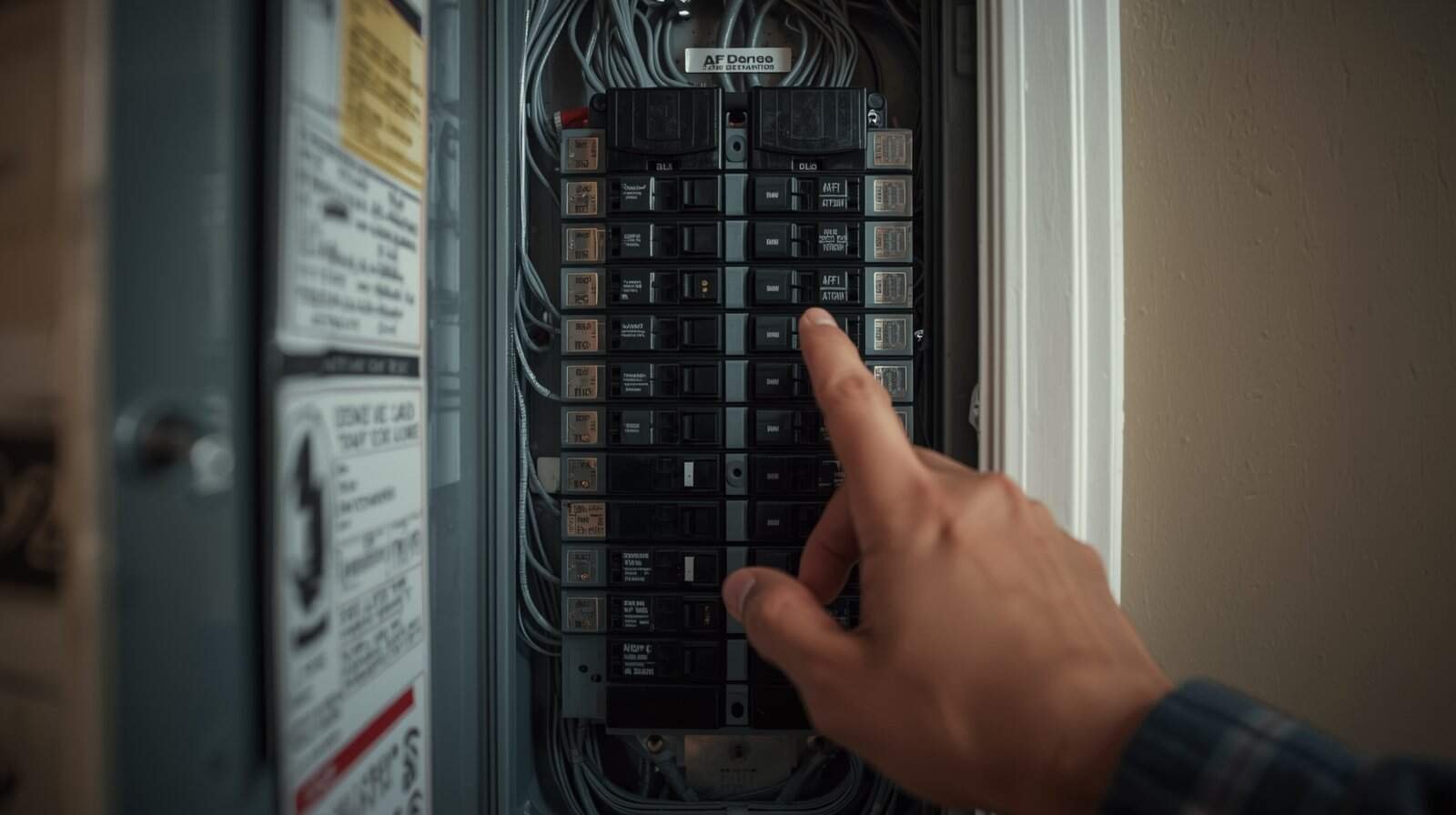
An AFCI breaker that trips after power is restored should be treated as a warning, not simply as a nuisance caused by the outage. Arc-fault circuit interrupters are designed to recognize electrical patterns associated with potentially dangerous arcing and shut the circuit off before damaged wiring, loose connections, or faulty cords can become a fire hazard.
Power restoration may reveal a problem that was already present, or a device may trip as appliances and electronics restart. The safest first step is to unplug loads on the affected circuit, reset the breaker once if there are no signs of heat, burning, moisture, or damage, and reconnect devices one at a time. If the AFCI trips again with everything unplugged, stop resetting it and have the circuit evaluated.
What an AFCI Breaker Is Looking For
AFCI protection monitors the electrical behavior of a circuit and is designed to recognize characteristics associated with unintended arcing. These faults can occur in branch-circuit wiring, at loose connections, or in damaged appliance and extension cords.
Unlike a simple overload, an arc fault may involve current levels that are not high enough to trip an ordinary breaker quickly. That is why AFCI protection is used in addition to conventional overcurrent protection.
Common causes of real arc faults include damaged insulation, loose connections, crushed or bent cords, aging wiring, and wiring damaged by heat, moisture, fasteners, or pests.
Why an AFCI May Trip When Power Comes Back On
When utility power returns after an outage, many devices may restart at nearly the same time. Motors, power supplies, chargers, appliances, and electronics can all begin drawing current again.
That restoration event can expose an existing weak connection, damaged cord, failing appliance, or wiring fault that was not obvious before the outage. It can also make an already-marginal connection behave differently as loads switch on.
The important point is that restoration does not automatically “confuse” the AFCI. A trip may be responding to a real electrical condition, and the breaker should not be defeated simply because the timing coincides with power coming back on.
First Determine Whether the Trip Is AFCI, GFCI, or Overload Related
Some modern breakers provide AFCI protection only, while others combine AFCI and GFCI functions. The breaker label, indicator lights, or diagnostic code may help identify why it opened.
| Protection type | Primary hazard detected | Typical causes after an outage |
|---|---|---|
| Standard breaker | Overcurrent and short circuit | Too many loads restarting, shorted appliance, damaged wiring |
| AFCI | Certain dangerous arcing patterns | Loose connection, damaged cord, failing appliance, damaged branch wiring |
| GFCI | Current leaking away from the intended path | Moisture, wet equipment, damaged insulation, faulty appliance |
| Dual-function AFCI/GFCI | Arc-fault and ground-fault conditions | Either type of fault may be involved |
If the affected device is actually a GFCI or dual-function breaker, review GFCI Keeps Tripping After an Outage for moisture and leakage-current patterns that differ from a pure AFCI trip.
Damaged Extension Cords Can Trigger AFCI Protection
Extension cords and appliance cords are common places for arcing faults to develop. A cord may have been crushed under furniture, pinched in a doorway, bent sharply near a plug, exposed to storm debris, or damaged internally even though the outer jacket still looks mostly normal.
After an outage, homeowners often rearrange appliances and temporary wiring, which can bring questionable cords back into service. If the AFCI holds with the extension cord unplugged but trips when that cord is reconnected, remove the cord from service rather than repeatedly resetting the breaker.
See Why Extension Cords Trip Breakers After an Outage for the differences between overload, cord damage, voltage drop, AFCI trips, and GFCI trips.
Loose Plugs and Receptacles Matter
A loose plug blade, worn receptacle contact, poor connection at a device, or damaged cord end can produce intermittent electrical contact. That type of condition can create heat and arcing.
Stop using a receptacle if plugs fit unusually loosely, the faceplate or outlet is discolored, the device buzzes or crackles, or the plug becomes hot during normal use.
Do not remove the receptacle or open the electrical box during an outage unless you are qualified to perform electrical work. A loose or damaged receptacle is an electrician-level repair.
Appliances Can Be the Trigger Without the Breaker Being Defective
If the AFCI resets normally with everything unplugged but trips when one specific appliance is connected or started, that appliance becomes a strong suspect.
The problem may be a damaged power cord, failing motor, internal switch, worn connection, or another fault inside the appliance. Do not assume the breaker is malfunctioning simply because the appliance worked before the outage.
If the same appliance causes repeated trips on the same AFCI-protected circuit, stop using it until the appliance or circuit can be evaluated.
Do Not Label Every Appliance-Related Trip as “Electrical Noise”
Some homeowners are told that motors, treadmills, vacuum cleaners, dimmers, or power tools simply create “electrical noise” that AFCIs mistake for a fault. That explanation can be too casual.
Modern AFCIs are specifically designed to distinguish normal electrical behavior from hazardous arcing patterns. A trip associated with a particular device may still involve a damaged cord, worn switch, failing motor connection, poor plug contact, or compatibility issue that deserves diagnosis.
The correct response is to identify the device and pattern—not bypass the AFCI or replace it with a standard breaker.
Storm Moisture Can Change the Diagnosis
If the outage followed heavy rain, flooding, roof damage, or wind-driven water, moisture may be part of the problem. Wet receptacles, damp cords, water-damaged devices, and compromised wiring can create ground faults, arcing, corrosion, or multiple fault conditions.
Do not reset an AFCI repeatedly when the affected area or equipment may be wet. Keep power off to visibly wet or water-damaged electrical equipment and have it evaluated before reuse.
If a dual-function AFCI/GFCI breaker is involved, moisture may trigger the ground-fault portion of the device rather than the arc-fault portion.
A Safe Homeowner Troubleshooting Sequence
If there are no signs of smoke, heat, moisture, burning, or physical damage, use this conservative sequence:
- Turn off or unplug devices on the affected circuit.
- Inspect accessible cords, plugs, and receptacles. Do not remove covers or expose wiring.
- Reset the AFCI breaker once.
- See whether it stays set with all portable loads disconnected.
- Reconnect one device at a time.
- Stop when a specific device or cord causes the trip.
- Leave that device disconnected.
If the breaker trips immediately after reset even with loads disconnected, use Breaker Trips Immediately After Reset rather than continuing to cycle it.
If the AFCI Stays On With Everything Unplugged
If the breaker remains set after all portable loads are removed, reconnect devices one at a time and wait long enough for motor-driven or cycling equipment to start.
This can help distinguish a circuit problem from a specific appliance or cord problem. If one item consistently causes the trip, keep that item disconnected.
Do not continue reconnecting additional loads after the suspected device has reproduced the fault.
If the AFCI Trips With Everything Unplugged
A trip with all accessible loads disconnected is more concerning because the problem may be in fixed wiring, a hardwired appliance, a receptacle, a switch, a light fixture, or the breaker itself.
At that point, homeowner troubleshooting should stop. Do not open junction boxes, remove receptacles, or probe the panel trying to find the fault.
A qualified electrician can inspect the protected circuit, fixed connections, breaker diagnostics, and branch wiring safely.
What If the Breaker Will Not Reset at All?
Many breakers must be moved fully to the OFF position before they can be reset to ON. Follow the breaker manufacturer’s normal reset procedure.
If the breaker will not latch, immediately trips again, feels damaged, or shows a diagnostic indication you do not understand, leave it off.
Do not force the handle, hold it in place, or substitute a higher-rated breaker.
Do Not Replace an AFCI With a Standard Breaker to Stop the Trips
An AFCI may be required for that circuit, and removing the protection can eliminate a safety layer intended to reduce fire risk from electrical arcing.
Likewise, do not increase the breaker amperage because the circuit keeps tripping. Breaker size is coordinated with conductor size and circuit design.
The correct repair is to identify whether the problem is the connected equipment, fixed wiring, receptacle, connection, or the AFCI device itself.
Can an AFCI Breaker Fail?
Yes, circuit breakers and electronic protection devices can fail. But a failed AFCI should be a diagnosis, not the starting assumption.
If the breaker trips with all loads disconnected, an electrician may evaluate the breaker along with the branch circuit. Replacing the AFCI without checking for wiring faults can leave the real problem unresolved.
When Post-Outage AFCI Tripping Is More Serious
Stop troubleshooting immediately if the AFCI trip occurs with any of these symptoms:
- Burning or hot-plastic odor
- Buzzing, sizzling, or crackling from a receptacle, switch, or wall
- Scorched or melted plugs
- Visible sparking
- Hot outlets or wall plates
- Water intrusion or flooding
- Repeated trips with all loads disconnected
- Multiple circuits behaving abnormally after restoration
Those symptoms move the problem beyond ordinary appliance-by-appliance troubleshooting.
When to Call an Electrician
Call an electrician when the AFCI trips with everything unplugged, trips repeatedly after one safe reset, the circuit includes hardwired equipment you cannot isolate, the breaker will not reset normally, or there are signs of heat, damage, arcing, or water exposure.
Use When to Call an Electrician After an Outage for broader post-outage warning signs and escalation guidance.
AFCI Breaker After Outage FAQ
Why did only one AFCI breaker trip when the power came back?
The issue may be limited to that circuit or one device connected to it. A damaged cord, loose connection, appliance fault, or branch-wiring problem can affect one AFCI-protected circuit while the rest of the home remains normal.
Does an AFCI trip mean there is definitely an arc fault?
Not necessarily. AFCI breakers can also provide conventional overload and short-circuit protection, and some models combine AFCI and GFCI functions. The trip pattern and breaker diagnostics help narrow the cause.
Can I reset an AFCI breaker after an outage?
If there are no signs of burning, heat, moisture, or damage, disconnect portable loads and reset it once using the normal breaker procedure. If it trips again, stop repeating the reset and identify the cause.
Why does the AFCI stay on until I plug in one appliance?
That pattern points toward the appliance, its cord, or its connection. Keep the item disconnected until it has been evaluated.
Should I replace the AFCI breaker if it keeps tripping?
Not automatically. Repeated trips can indicate a real wiring or appliance problem. An electrician can determine whether the AFCI itself is defective after checking the protected circuit.
Bottom Line
An AFCI breaker that trips after power restoration is not something to defeat or ignore. The outage may have exposed a damaged cord, loose connection, appliance fault, moisture problem, or wiring condition that becomes apparent when loads restart.
Disconnect portable loads, inspect only what is safely accessible, reset the breaker once, and reconnect devices one at a time. If the AFCI trips with everything unplugged, immediately trips again, or is accompanied by heat, burning, buzzing, moisture, or visible damage, leave the circuit off and have it evaluated.