


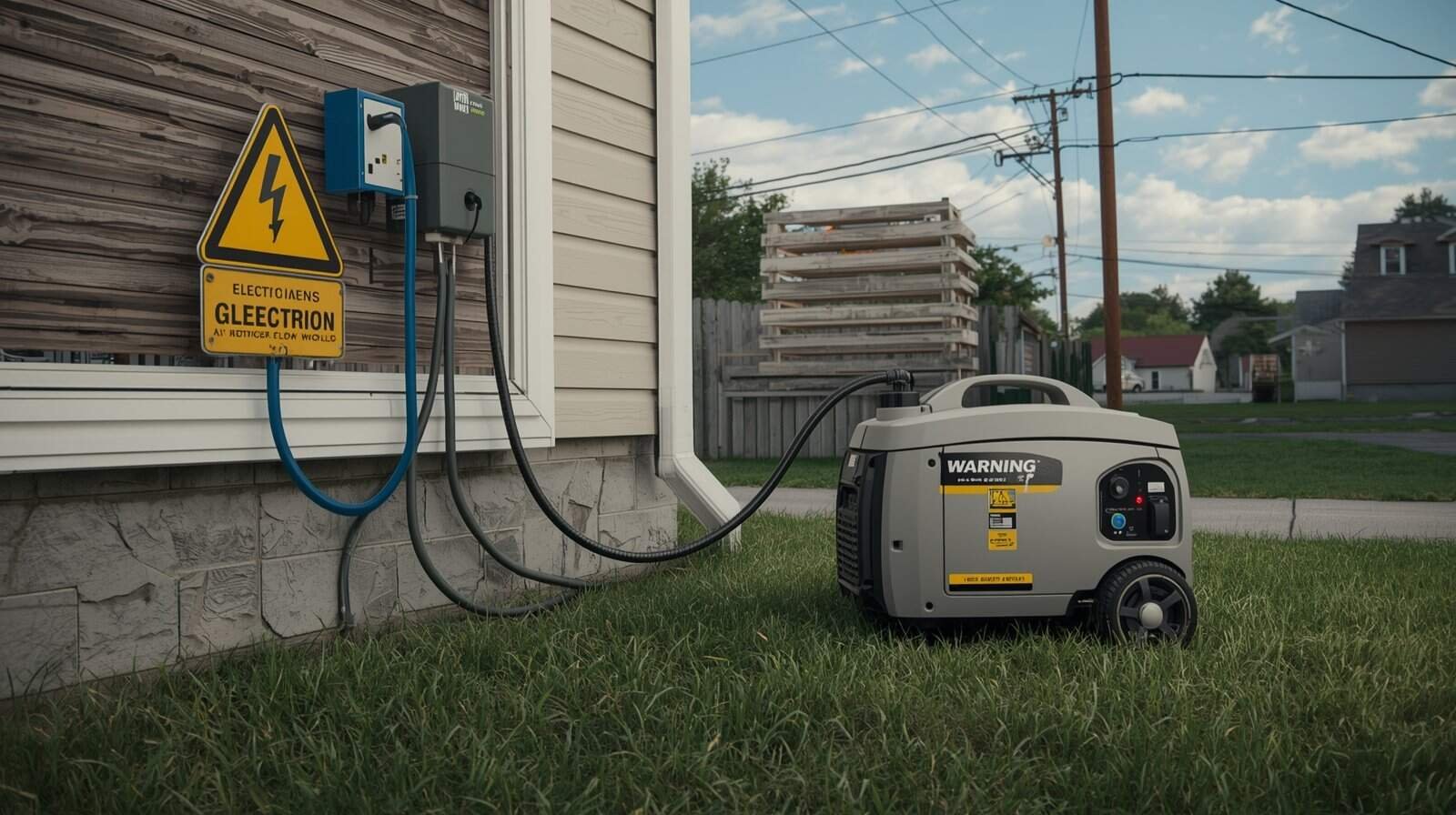
Backfeeding is one of the most dangerous generator mistakes a homeowner can make because it can happen quietly. The lights may come on, appliances may run, and the generator may sound normal, but power may be flowing through an unsafe path that can energize utility lines, damage equipment, or create shock and fire hazards.
Backfeeding usually happens when a portable generator is connected to a home without approved transfer equipment, or when someone bypasses a transfer switch, interlock, inlet, or breaker sequence because the house is not receiving power as expected. If you suspect backfeeding, stop using the generator and do not keep testing.
What Backfeeding Really Means
Backfeeding occurs when generator power flows into wiring or utility lines in a direction the system was not designed to allow. Instead of generator power being safely isolated to selected household circuits, it can energize parts of the electrical system that should remain disconnected from the generator.
This is dangerous because utility workers, neighbors, and household members may assume lines or circuits are de-energized when they are not. A portable generator can send power back through a home’s electrical system and into utility infrastructure if the home is not isolated correctly.
Approved transfer switches, interlock kits, and inlet systems are designed to prevent this. They create a controlled path for generator power while keeping utility power and generator power separated.
Why Backfeeding Is So Easy to Miss
Backfeeding does not always look dramatic. There may be no sparks, no smoke, no immediate breaker trip, and no obvious failure. That is part of what makes it so dangerous.
A homeowner may see lights turn on and assume the generator connection worked. In reality, power may be traveling through an unsafe path. The setup may “work” in the sense that electricity reaches some circuits, but that does not mean it is safe, legal, or properly isolated.
This is why generator safety is not just about whether the house gets power. It is about how the power reaches the house. If the connection path is not approved and clearly understood, the setup should not be used.
Common Ways Homeowners Accidentally Create Backfeeding
Backfeeding usually comes from attempts to make a generator power more of the home than it can safely support. It can also happen when someone tries to work around a transfer switch, inlet, or interlock that is confusing or not delivering power.
Common unsafe situations include:
- Plugging a generator into a wall outlet
- Plugging a generator into a dryer outlet
- Using a homemade “suicide cord” or double-male cord
- Using adapters to force a generator plug to fit a home connection
- Bypassing a transfer switch or interlock
- Changing breaker positions without understanding the transfer sequence
- Using an RV-style generator outlet as if it were automatically safe for home backup
- Removing or modifying grounding, neutral, or GFCI protection to stop nuisance trips
If outlet shape, voltage, amperage, or plug compatibility is part of the confusion, review Generator Outlet Types Explained. A plug that physically fits does not prove the connection is safe for home backup.
Subtle Warning Signs of Backfeeding
Backfeeding may not announce itself clearly, but there are warning patterns that should make you stop and reassess. Any unexpected power behavior around a generator and house connection deserves caution.
- Power appears in circuits that should be off
- Lights outside the intended circuit area flicker or turn on
- The generator strains more than the connected load should require
- Breakers behave unpredictably or trip repeatedly
- The transfer switch or interlock does not behave as expected
- The generator only works after using an adapter or unusual cord setup
- GFCI protection trips when the generator connects to the home
- Someone suggests turning breakers on or off randomly to “find the right combination”
These symptoms do not prove backfeeding by themselves, but they are enough to stop testing. If you are unsure whether the problem is backfeeding, transfer equipment, outlet mismatch, or another generator issue, start with Generator Problems Explained instead of improvising a connection.
Backfeeding vs. Normal Generator Connection Problems
Some backfeeding risks begin as ordinary troubleshooting frustration. The generator runs, but the house does not receive power. The inlet seems connected, but selected circuits stay off. The transfer switch clicks, but no circuits work. The interlock looks installed, but the generator breaker will not energize the expected loads.
Those symptoms can tempt homeowners to bypass the safe equipment and “try another way.” That is where a normal connection problem can turn into a dangerous backfeeding situation.
If your setup uses an interlock system, review interlock kit installed but generator power still doesn’t work to understand common blocking points. If the generator runs but the house has no power, use generator runs but house has no power or the visual guide here: Generator Runs but House Has No Power — Safety Setup Flowchart.
The key rule is simple: if the approved transfer path is not working, fix the transfer path. Do not create a second, unapproved path.
Why Interlocks and Transfer Switches Matter
Interlock kits and transfer switches exist to prevent generator power and utility power from being connected at the same time. They also help direct generator power only where it is intended to go.
A transfer switch may feed selected circuits. An interlock may prevent the main breaker and generator breaker from being on together. An inlet box provides a safer connection point than running cords through windows or improvising with outlets.
When these systems are installed and used correctly, they reduce the risk of backfeeding. When they are bypassed, misunderstood, or paired with incompatible generator equipment, the risk returns.
Transfer switch malfunctions can be subtle, especially when switches click but do not deliver power. See transfer switch clicks but no circuits get power for a deeper explanation of that failure mode.
Neutral Bonding Can Add to the Confusion
Some generator connection problems involve neutral bonding, especially when GFCI protection trips or a transfer setup behaves unexpectedly. A floating neutral generator and a bonded neutral generator are not automatically interchangeable in every home backup setup.
This does not mean the homeowner should remove a bonding jumper, lift a ground, bypass GFCI protection, or make a special adapter. Those changes can create serious safety issues if they are not supported by the generator manual, transfer equipment instructions, and a qualified electrician.
If GFCI trips, transfer behavior, or neutral/ground confusion is part of the problem, review Floating Neutral vs Bonded Neutral Generators. Neutral bonding is a compatibility and safety topic, not a trial-and-error fix.
Why Backfeeding Is Dangerous to Utility Workers
Utility workers may be repairing lines they believe are de-energized. If a home generator is backfeeding the line, that equipment can become unexpectedly energized.
This creates a serious shock and electrocution hazard. The danger is not limited to your own home. Unsafe generator connections can place people outside your property at risk.
This is one of the biggest reasons backfeeding is treated so seriously. A generator may seem small compared with the utility grid, but it can still create a dangerous voltage condition on equipment that should be dead.
Why Backfeeding Is Dangerous to Your Home
Backfeeding can also damage your own equipment. A generator connected through the wrong path can overload wiring, overheat cords, damage appliances, trip breakers unpredictably, or expose transfer equipment to conditions it was not designed to handle.
If utility power returns while the generator is connected improperly, the generator and household wiring may be exposed to a dangerous conflict between power sources. That can damage the generator, appliances, breakers, outlets, transfer equipment, or service components.
Even if nothing fails immediately, the setup may still have stressed equipment or created hidden damage. That is why suspected backfeeding should be inspected before the generator is used again.
What to Do If Backfeeding Is Suspected
If backfeeding is suspected, stop using the generator. Shut it down if you can do so safely, disconnect it using the approved procedure, and do not keep testing circuits.
Do not reset breakers repeatedly. Do not try a different outlet. Do not switch to a dryer outlet. Do not change plug ends. Do not bypass the transfer switch or interlock. Do not remove grounding or neutral connections to make a trip stop.
Backfeeding risk belongs in the stop-and-call category. For a broader shutdown guide, see When to Stop Using a Generator. If the problem involves backfeeding, shock risk, repeated trips, transfer equipment, wet electrical equipment, or house wiring, stop and get qualified help.
If you are unsure whether the problem is backfeeding, transfer-switch behavior, outlet mismatch, neutral bonding, or a generator load issue, do not keep experimenting with cords or breakers. Use the Generator Troubleshooting Hub to find the safest next step without bypassing transfer equipment.
When Professional Help Is Mandatory
Professional help is mandatory if backfeeding has occurred or is suspected. The system should be inspected before generator use resumes.
You should also call a qualified electrician if the issue involves:
- Unexpected energized circuits
- Transfer switch or interlock malfunction
- Generator breaker trips when connected to the house
- GFCI trips during transfer connection
- Neutral bonding uncertainty
- Modified cords, adapters, or questionable plug arrangements
- Partial house power that does not match the transfer setup
- Any need to open the electrical panel or transfer equipment
A qualified electrician can verify the inlet, transfer equipment, breaker arrangement, neutral configuration, grounding, generator outlet, cord rating, and installed instructions. That review is much safer than trying to solve the problem during an outage.
How to Prevent Backfeeding Before the Next Outage
The best time to prevent backfeeding is before the storm. Make sure the generator, inlet, cord, transfer equipment, and panel instructions are matched and clearly labeled. Keep the generator manual and transfer-equipment instructions with your outage supplies.
Your household should know:
- Where the generator can be placed safely outdoors
- Which cord connects to the inlet
- Which transfer switch or interlock sequence must be followed
- Which circuits are intended to receive generator power
- Which appliances should not be used on generator power
- Who to call if the transfer setup does not work
If the safe connection path is confusing on a calm day, it will be worse in the dark during an outage. Simplify the instructions now so nobody is tempted to improvise later.
FAQ
Can backfeeding happen if my generator seems to be working?
Yes. Backfeeding can occur even when lights turn on and appliances run. The danger is not whether power reaches the house; it is whether power is reaching the house through an approved and isolated connection path.
Is plugging a generator into a dryer outlet backfeeding?
Yes, using a dryer outlet or wall outlet to feed generator power into the home is unsafe and can create backfeeding. Use approved transfer equipment and a proper inlet instead.
Can an interlock or transfer switch prevent backfeeding?
Yes, when properly installed, compatible, and used correctly. If the interlock or transfer switch does not behave as expected, do not bypass it. Stop and have the setup checked.
What should I do if I think I backfed my house?
Shut the generator down if it is safe, disconnect it using the approved procedure, and do not restart the setup until a qualified electrician verifies that the system is safe.
Conclusion
Backfeeding is dangerous because it can look like success. The home may have power, the generator may sound normal, and nothing may trip immediately. But if the generator is feeding the house through an unapproved path, utility lines, home wiring, and connected equipment may be energized in unsafe ways.
The safe solution is never a shortcut cord, dryer outlet, wall outlet, homemade adapter, or bypassed transfer device. Use approved transfer equipment, follow the correct sequence, and stop immediately if the system behaves in a way you cannot explain. When backfeeding is suspected, shut down and get qualified help before using the generator again.