


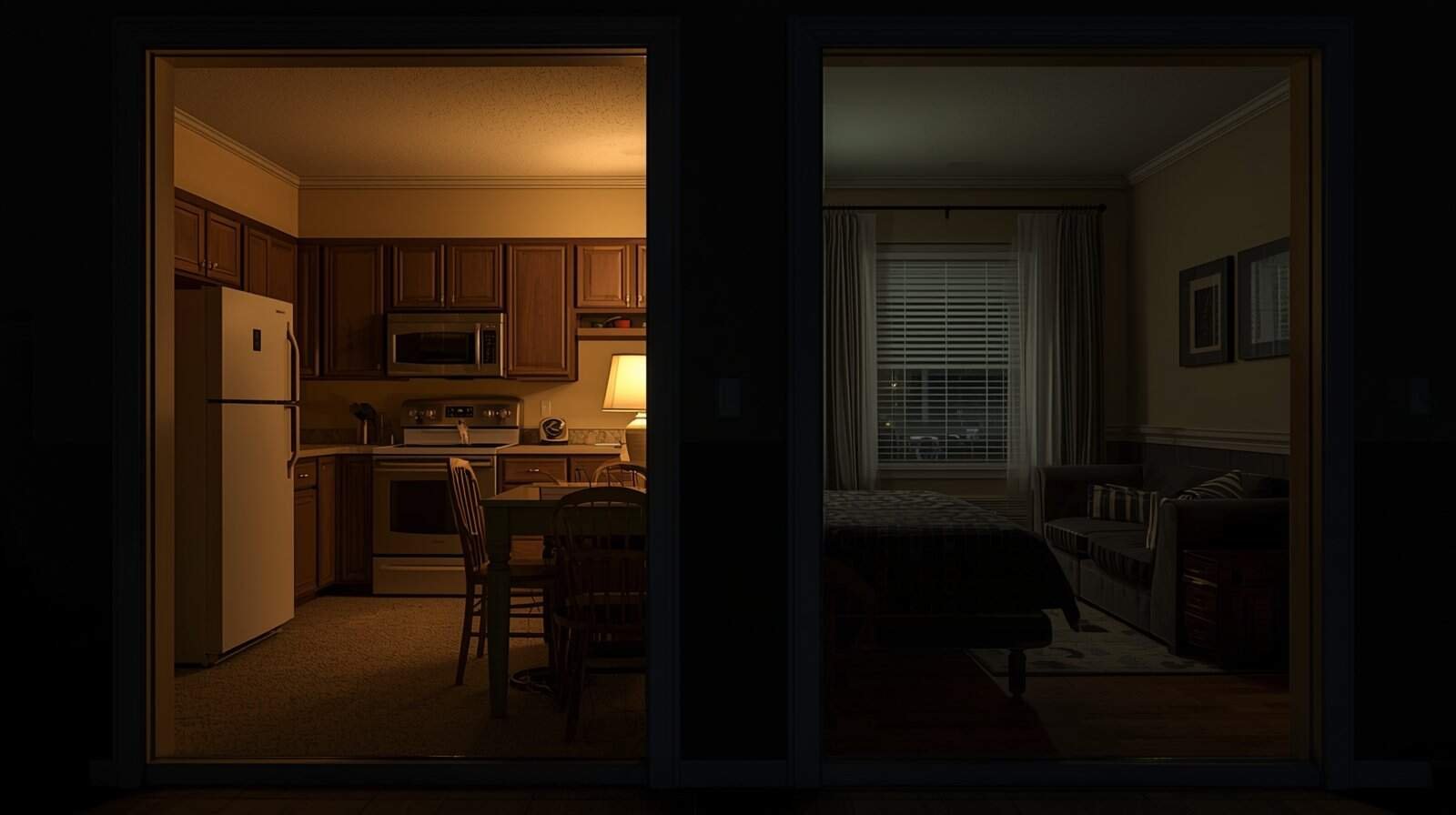
When roughly half of a home has power while the other half does not, it usually signals a service-level electrical issue — not a single outlet problem.
This pattern often means one “leg” of the home’s electrical supply is no longer delivering power. While some lights and outlets continue working, others remain completely dead. This imbalance should be taken seriously.
This article focuses on whole-home partial power loss patterns and safe next steps.
How Home Electrical Service Is Structured
Most homes in the United States receive 240-volt split-phase service. That service is divided into two 120-volt “hot” legs. Each leg powers alternating rows of breakers inside the panel.
If one leg fails, approximately half the home’s circuits lose power while the other half continue operating normally.
This is why kitchens may still work while bedrooms go dark — or vice versa.
Common Causes of Half-House Power Loss
Utility-Side Service Failure
Problems with the service drop, transformer, or meter base can interrupt one phase of incoming power. Storm damage and loose connections are common triggers.
Main Breaker or Panel Issue
A failed or partially tripped main breaker can interrupt power to one side of the panel. Internal breaker failure, though less common, is possible.
Loose or Damaged Neutral Connection
A failing neutral connection can create unstable voltage conditions. Lights may flicker, brighten, or dim unpredictably. Electronics may behave erratically.
Symptoms That Suggest a Service-Level Problem
- Large appliances (240V) stop working entirely
- Multiple rooms lose power at once
- Lights flicker across different areas of the home
- Some outlets test dead while others remain active
- Power loss does not align with a single branch breaker
If nearby homes have full power while yours does not, review Power Outage but Neighbors Have Power for comparison guidance.
Safe Checks You Can Perform
- Inspect the main panel for a clearly tripped breaker
- Reset breakers once — firmly but without forcing
- Note which rooms and major appliances are affected
If resetting does not restore balance, do not continue toggling breakers repeatedly.
What Not to Do
- Do not remove the panel cover
- Do not touch exposed wiring
- Do not assume the problem is minor if half the house still works
- Do not ignore flickering, buzzing, or heat
For general breaker-related troubleshooting boundaries, see Breaker Won’t Reset.
When to Call for Professional Help
Contact a licensed electrician or your utility provider if:
- Half the home remains without power after a single reset attempt
- Lights fluctuate in brightness
- You hear buzzing from the panel or meter area
- Appliances behave unpredictably
Clear escalation guidance is outlined in When to Call an Electrician After an Outage.
If you prefer a quick visual decision path, see the Half House Has No Power Safety Flowchart.
Conclusion
When half the house has power, the issue is rarely isolated to a single outlet or appliance. It typically involves service-level supply imbalance that can escalate quickly.
Perform only safe surface checks, document symptoms clearly, and escalate promptly if balance is not restored. Addressing partial power loss early helps protect appliances, wiring, and overall household safety.