


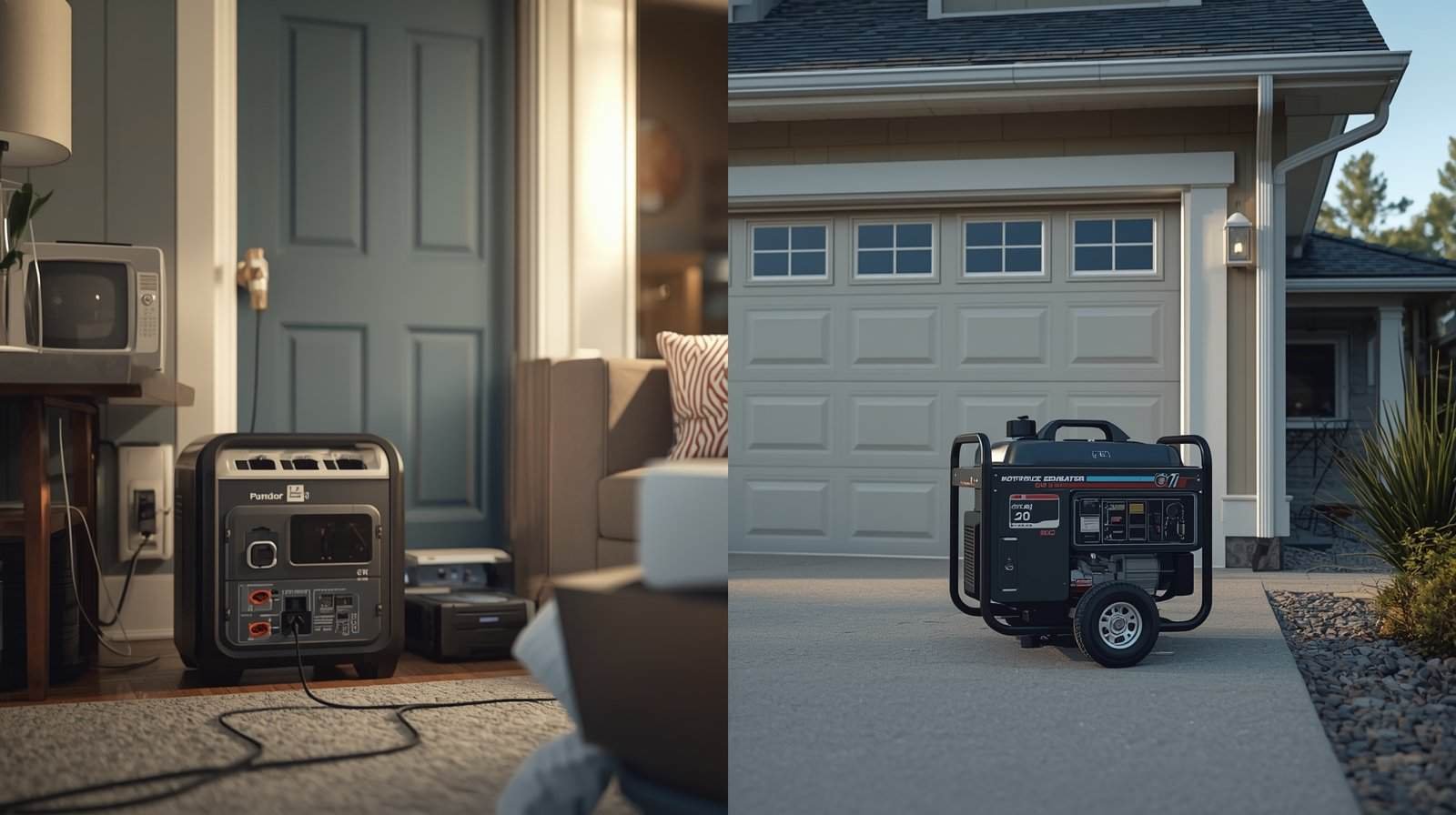
When the power goes out, most homeowners quickly realize they don’t just need backup power — they need the right kind of backup power. Two of the most common options are portable power stations and fuel-powered generators. While they’re often grouped together, they operate very differently and solve very different problems.
This guide explains how each system works, where each one performs best, where each one falls short, and how to choose based on realistic household needs — without brand hype or sales pressure.
What Is a Portable Power Station?
A portable power station is a rechargeable battery system paired with an inverter. It stores electricity in an internal battery and delivers usable power through AC outlets, USB ports, or DC connections. Unlike generators, it does not burn fuel or produce exhaust.
How It Works
- Electricity is stored in an internal lithium or similar battery
- An inverter converts DC battery power into standard household AC power
- Devices plug directly into the unit
- Recharging occurs through wall outlets, vehicles, or compatible solar panels
Where It Excels
- Indoor-safe emergency power
- Medical devices and electronics
- Apartments or HOA-restricted properties
- Short-duration outages
Limitations to Understand
- Limited total output capacity (wattage ceiling)
- Runtime is restricted by battery size
- Recharge time can be lengthy without solar input
- May not support high-demand appliances
Battery systems can also develop charging or capacity issues over time. If your unit fails to recharge properly, see what to do when a power station won’t charge.
What Is a Generator?
A generator produces electricity by burning fuel such as gasoline, propane, or diesel. An internal combustion engine spins an alternator, creating electrical output as long as fuel is supplied.
How It Works
- Fuel powers a combustion engine
- The engine rotates an alternator
- Electricity is produced continuously during operation
Where It Excels
- Extended multi-day outages
- High-demand appliances (well pumps, HVAC, refrigerators)
- Partial-home backup through transfer equipment
Limitations to Understand
- Must be operated outdoors only
- Produces carbon monoxide (CO)
- Requires fuel storage and rotation
- Ongoing mechanical maintenance required
- Noise and neighborhood considerations
Side-by-Side Comparison
| Feature | Portable Power Station | Generator |
|---|---|---|
| Energy Source | Stored Battery Power | Gas / Propane / Diesel Fuel |
| Indoor Safe | Yes | No |
| Noise Level | Very Quiet | Loud |
| Maintenance | Minimal | Moderate to High |
| Runtime | Limited to Battery Capacity | Extended With Refueling |
| High-Wattage Appliances | Often Not Supported | Typically Supported |
Choosing Based on Realistic Scenarios
Apartments and Condos
Generators are unsafe indoors and often prohibited by building rules. Portable power stations are typically the only practical option.
Short, Occasional Outages
If outages in your area typically last a few hours, a battery-based system can handle lighting, charging, and essential electronics without fuel logistics.
Medical or Sensitive Electronics
Portable power stations provide quiet, exhaust-free power and stable output that is often better suited for indoor medical devices.
Extended Multi-Day Outages
When outages last multiple days, generators offer sustained output — provided fuel is available and managed safely. Understanding realistic runtime expectations is critical. See How Long a Generator Can Run Safely for guidance on safe operation windows and fuel planning.
Whole-Home or High-Draw Appliances
Electric ranges, central HVAC systems, well pumps, and large refrigerators typically require generator-level output. Battery systems may not sustain these loads for long. Proper sizing matters — see What Size Generator Do I Need? for a practical wattage planning guide.
A Practical Decision Framework
Ask yourself three questions:
- How long do outages typically last?
- What appliances must remain powered?
- Can I safely store and manage fuel?
If outages are short and power needs are modest, a portable power station may be sufficient. If outages are frequent, prolonged, or require high-demand appliances, a generator may be necessary.
Some households use both — a battery system for immediate indoor needs and a generator for extended outages.
Conclusion
Portable power stations and generators serve different roles in emergency preparedness. One prioritizes indoor safety, simplicity, and quiet operation. The other prioritizes sustained power and higher output.
The safest choice is the one that aligns with your home’s load requirements, outage patterns, and ability to operate equipment responsibly. Backup power is not about maximum wattage — it is about reliable, safe planning.