


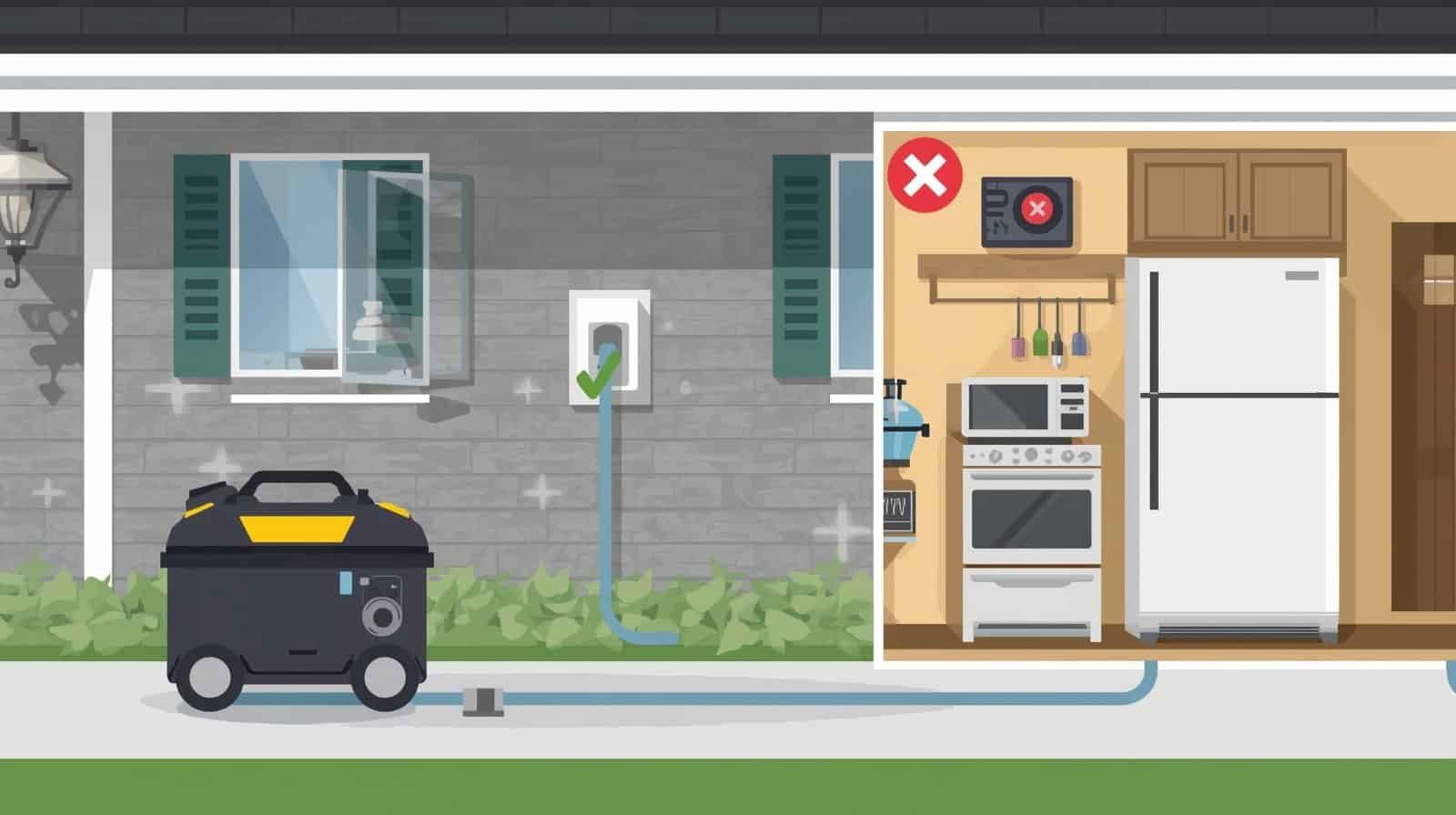
Short version: When your generator powers some devices (lights, chargers) but not others (fridge, microwave, well pump), it’s usually a startup surge, overload, or voltage sensitivity issue—not a random failure.
Safety note: If you smell burning plastic, hear buzzing/crackling, or appliances are cycling on/off repeatedly, stop testing and shut the generator down.
If you suspect unstable generator output, see: Visual Guide: Why Generator Power Feels Unstable.
Visual Guide: Why Some Generator Loads Work (And Others Won’t)
What This Visual Guide Covers
- Why motors/compressors need more power for a few seconds just to start
- Common overload patterns that make “some things work” while others fail
- Safe adjustments to try (reduce load, redistribute outlets, shorten cords)
- Clear STOP conditions that mean “don’t keep testing”
Why This Happens (The Simple Explanation)
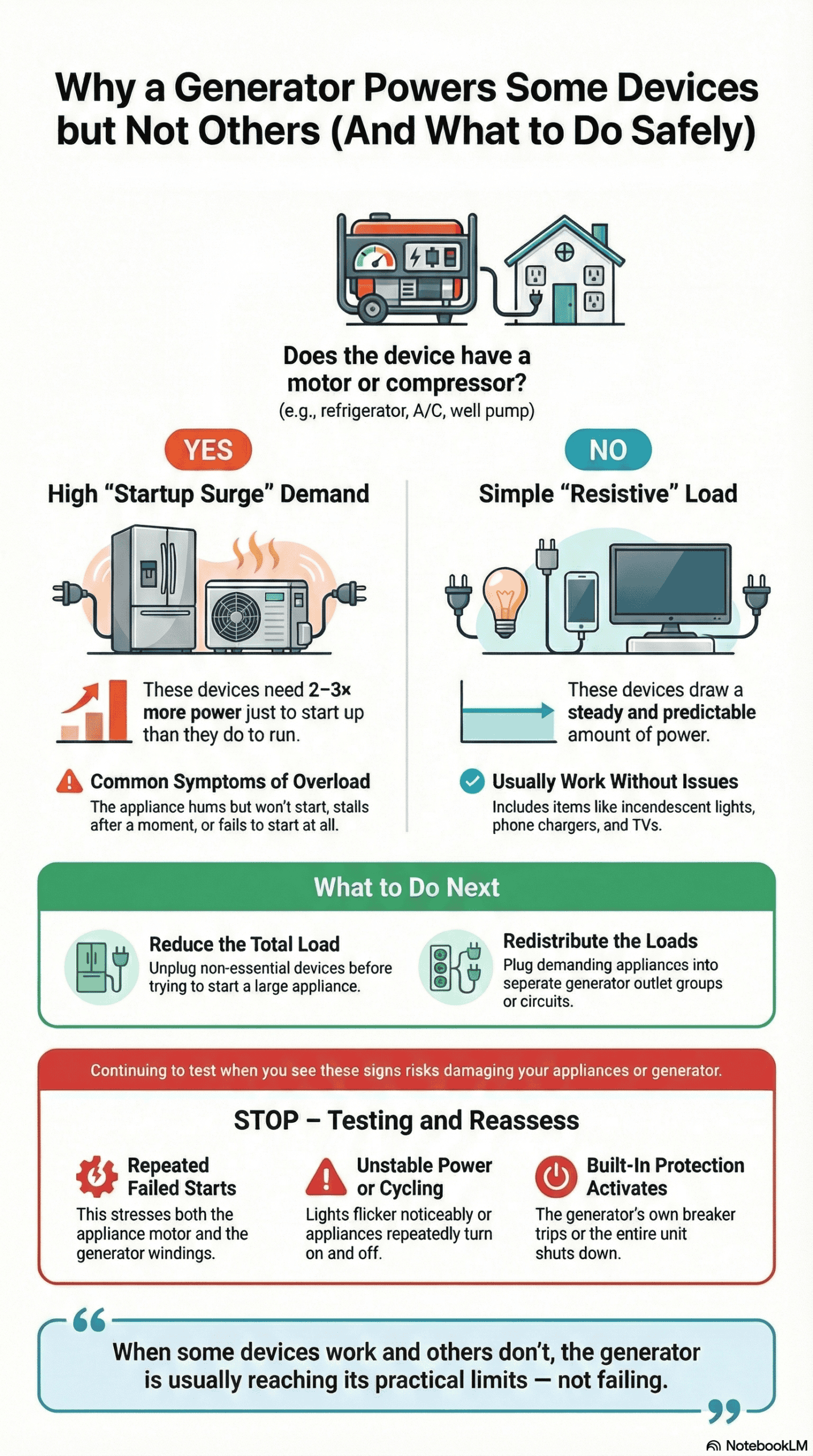
Generators do best with steady, predictable loads. Many big appliances are the opposite: they demand a short burst of extra power at startup. If the generator can’t supply that surge, you may see partial power behavior—small devices keep working while a fridge, pump, or microwave won’t start.
1) Startup surge is the #1 culprit
Motors and compressors commonly need 2–3× their running watts for a few seconds. If the generator is already carrying other loads, that startup surge can push it past its practical limit.
2) Voltage drop under load can make electronics “refuse” to run
Modern electronics often shut down when voltage dips outside safe ranges. That can look like “the generator won’t power it,” when it’s really the device protecting itself.
3) One outlet group can overload even if the generator isn’t maxed out
Some generators have outlet groups on separate breakers. If multiple heavy loads are on the same group, that breaker can trip or voltage can sag on that side while other outlets seem fine.
Safe Steps to Try (In Order)
- Reduce the total load: unplug non-essential items first, then try one large appliance at a time.
- Let the generator stabilize: run it for 2–3 minutes with light load before starting a big motor load.
- Redistribute loads: move the “problem appliance” to a different generator outlet group if available.
- Use the shortest, thickest extension cord you can: long/thin cords can drop voltage under load. (See: Extension Cord Sizing for Generators.)
- Stop repeated failed starts: if an appliance hums/stalls repeatedly, stop testing—this can damage motors and generator windings.
Common Mistakes to Avoid
- Assuming “some power” means everything is fine. Partial power can be a warning sign of overload or voltage instability.
- Plugging multiple heavy loads into one power strip or outlet group.
- Using thin household cords for high-demand appliances. Heat + voltage drop = trouble.
- Repeatedly forcing a motor/compressor to start. If it won’t start after a safe load reduction, stop.
When to Stop Testing and Reassess
- Burning smell (plastic, insulation, “fishy” odor)
- Buzzing, crackling, or arcing sounds from cords, plugs, outlets, or the panel
- Lights flicker hard or appliances cycle on/off repeatedly
- Generator breaker trips repeatedly even after reducing load
- UPS / medical devices alarm or sensitive electronics behave erratically
FAQ
Is my generator “bad” if only some things work?
Usually no. This pattern typically means the generator is reaching its practical limit during startup surge or experiencing voltage drop under load.
Why do lights work but my refrigerator won’t start?
Lights are usually steady, low-demand loads. Refrigerators have compressors that need a big startup surge. If the surge exceeds available capacity, the fridge may hum, stall, or fail to start.
Does a longer extension cord really matter?
Yes. Long or thin cords can reduce voltage at the appliance when it tries to start, making motor loads fail even when the generator “should” handle them.
What if nothing in the house works even though the generator is running?
That’s a different scenario—often a connection-path issue (inlet box / transfer equipment / panel settings). Use this flowchart to verify the safe setup path: Generator Runs but House Has No Power — Safety Setup Flowchart.
What if the generator power feels weak or unstable everywhere?
Stop using sensitive equipment and reassess. Unstable voltage or frequency can quietly damage motors and electronics. See: Visual Guide: Why Generator Power Feels Unstable.
Related Guides
Quick takeaway: When some devices work and others don’t, your generator is usually hitting startup surge limits or experiencing voltage drop—not randomly failing. Reduce load, redistribute outlets, use proper cords, and stop if warning signs appear.