


When the power goes out, food safety becomes a clock you can’t see. Refrigerators warm slowly, freezers hold longer, and the risk isn’t “Will this taste okay?” — it’s whether bacteria had enough time in the danger zone to multiply. The tricky part is that food can look and smell normal and still be unsafe.
This guide gives you practical, conservative decision rules for what to keep versus what to throw away during an extended outage. It also explains what changes the timeline, how to reduce risk while the power is out, and what to do safely once electricity returns. If you’re building a full multi-day plan, start with How to Safely Live Through a Multi-Day Power Outage at Home and use this as the food-specific playbook.
The Two Rules That Matter Most: Time and Temperature
Food safety during outages is mainly about two variables: how long food has been above safe refrigeration temperatures and how warm it got. Many households only track time because it’s easier, but temperature is what actually drives bacterial growth.
A refrigerator is considered safely cold at 40°F (about 4°C) or below. Above that, perishable foods enter the “danger zone,” and the longer they stay there, the higher the risk. Freezers are different: frozen food can remain safe as long as it stays frozen or partially frozen with ice crystals still present.
If you have a fridge thermometer, it helps enormously. If you don’t, you can still make safe calls by using conservative time-based rules and treating “unknown temperature” as higher risk.
How Long Food Typically Stays Safe Without Power
With the doors closed, most refrigerators hold safe temperatures for a limited period. A commonly used rule is that refrigerated food stays safe for about four hours if the door is kept closed. After that, temperatures can rise quickly, especially in a warm kitchen or if the fridge is frequently opened.
Freezers usually hold much longer. A full freezer can keep food frozen for roughly 48 hours, while a half-full freezer may hold for about 24 hours. These are approximations, not guarantees, because insulation, ambient temperature, and how full the freezer is make a big difference.
The safest mindset is to treat these timelines as “best case.” If you opened the doors repeatedly, the house is warm, or you’re unsure, assume less safe time — not more.
- Fridge: If power has been out 4+ hours and you don’t know the temperature, discard high-risk perishables.
- Freezer: If food is still frozen or has ice crystals, it can usually be refrozen or cooked safely.
- When in doubt: Choose safety over salvage — especially for meat, dairy, and leftovers.
What to Throw Away First (Highest Risk Foods)
Some foods become risky faster than others because they support rapid bacterial growth. These are the items you should be most cautious with once the refrigerator has been warm for several hours.
Discard perishable foods such as raw or cooked meat, poultry, seafood, deli meats, soft cheeses, milk, yogurt, leftovers, and any foods that were meant to be refrigerated after opening. Prepared foods like casseroles, soups, and cooked rice or pasta also become risky if they’ve been warm for extended periods.
Condiments are often confusing. Many condiments are acidic or high in sugar and can be more stable, but anything dairy-based (like creamy dressings) should be treated as higher risk if the fridge warmed significantly.
What May Still Be Safe (Lower Risk Foods)
Some foods are more forgiving. Whole fruits and vegetables (un-cut), hard cheeses, butter (in limited circumstances), and many sealed shelf-stable items are generally lower risk. Unopened juice, soda, and many condiments may also be safer, depending on ingredients and how warm they got.
Frozen foods that remained frozen are usually safe. If they partially thawed but are still cold with ice crystals, they can often be refrozen or cooked immediately. The key is to avoid repeated thaw-freeze cycles and to treat anything that sat warm and fully thawed as higher risk.
When your goal is safety, it’s reasonable to keep decisions simple: prioritize keeping foods that are shelf-stable or still frozen and discard foods that were warm and perishable.
How to Reduce Food Loss Safely During an Ongoing Outage
The single best way to protect food during an outage is to keep doors closed. Every door opening dumps cold air and replaces it with warmer air that must be cooled again — except the fridge can’t cool without power.
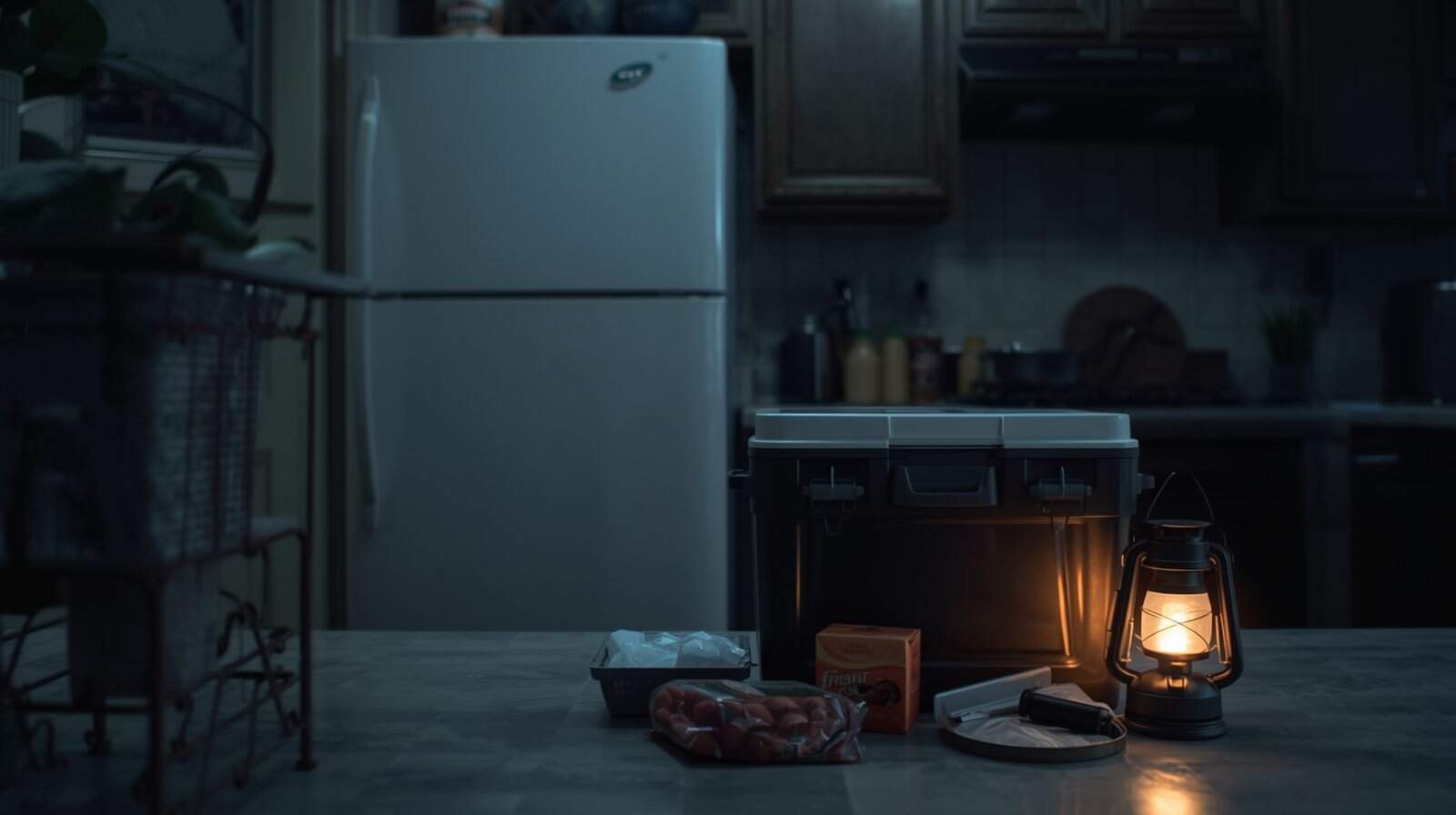
If you have ice, use it strategically. Move the most valuable perishables into a cooler with ice packs. Keep the cooler closed and open it only when needed. If temperatures are cold outside, you may be tempted to store food outdoors. That can work in some cases, but it introduces other risks (animals, contamination, unstable temperatures in sunlight). Use caution and avoid placing food where it can warm during the day and cool at night repeatedly.
This is also where a simple home supply plan pays off. If you want a broader checklist of what to stage for outages (including cooler strategy, lighting, and sanitation), see Power Outage Supply Planning: What to Prepare Beyond Flashlights and Batteries.
Special Situation: Medications That Must Stay Cold
Some households have medications that require refrigeration, and these can be higher priority than food. If you’re managing refrigerated medications, do not rely on guesswork. Use a dedicated cooler strategy and consult the medication guidance if you’re unsure about safe temperature ranges.
For medication-specific handling (and what to do if the cold chain breaks), use Medication Refrigeration During Power Outages: Safe Storage and Backup Planning.
After Power Returns: What to Check Before You Eat Anything
When electricity comes back, don’t treat that as instant safety. Your refrigerator may take hours to return to safe temperature. If you have a thermometer, confirm the fridge is back to 40°F or below before returning perishable foods. For the freezer, confirm items are still frozen or appropriately cold before refreezing.
Clean up leaks or spills promptly, especially from meat packages or thawed items, because cross-contamination can spread bacteria across shelves and drawers. Wash hands, sanitize surfaces, and discard any foods that were exposed to questionable fluids.
A simple rule helps: if you cannot confidently state that the food stayed cold enough, long enough, choose to discard it. The cost of food is real — but the cost of foodborne illness during a community-wide outage can be far worse.
A Practical “Keep vs Toss” Approach That Reduces Stress
Outages are stressful because you’re forced to make uncertain decisions. The best approach is to be conservative and consistent. Keep shelf-stable foods and foods that stayed frozen. Discard high-risk perishables once you cross safe time thresholds or lose temperature certainty.
Finally, consider using this experience to strengthen your future readiness. A basic plan for coolers, ice, shelf-stable meals, and a simple thermometer can reduce both risk and waste next time. For a full readiness framework that includes food, water, lighting, and family safety, use Emergency Preparedness for Power Outages: A Practical Home Readiness Checklist.