


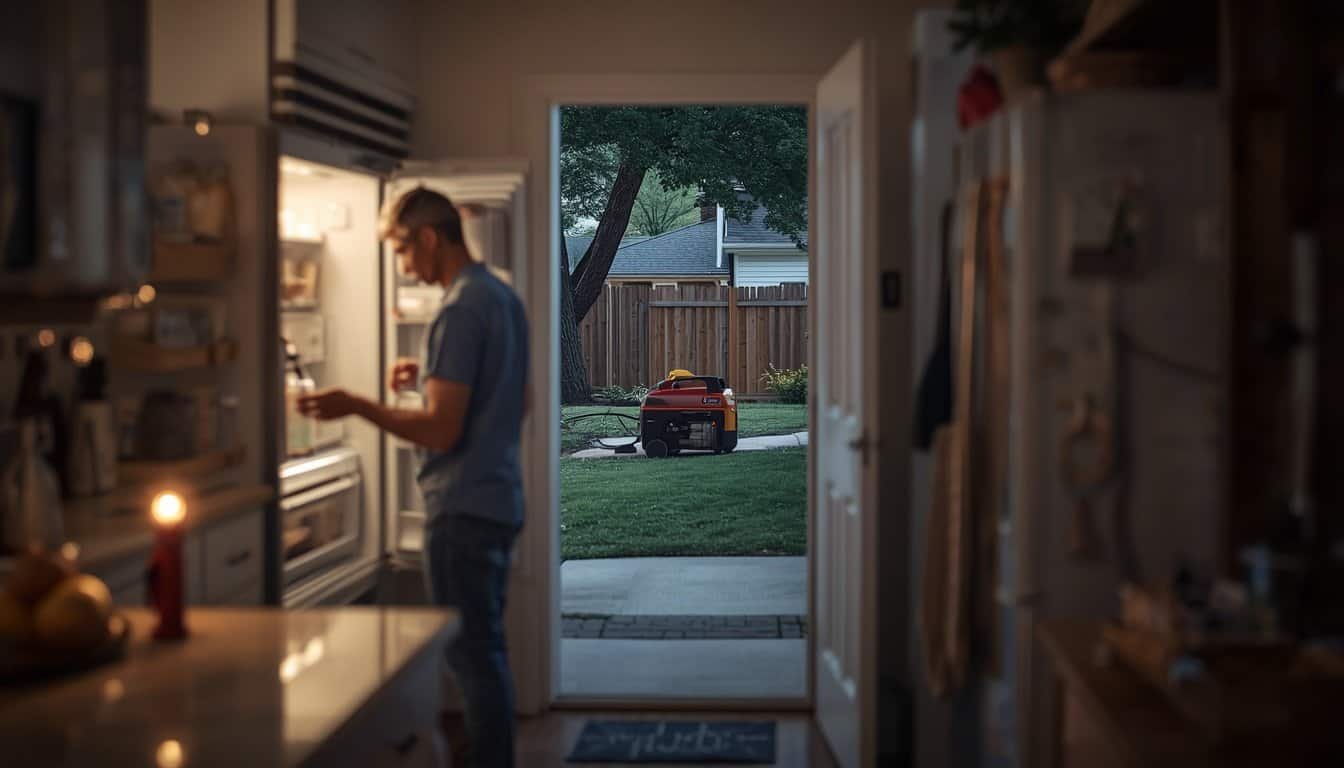
Running a refrigerator on a generator can help protect food during a power outage, but it needs to be done with the right priorities. The refrigerator is only one part of the plan. You also need safe generator placement, enough wattage for the compressor to start, the right cord setup, and a food-safety cutoff if the refrigerator was already too warm before you powered it again.
To run a refrigerator on a generator during an outage, place the generator outdoors and far from openings, confirm the refrigerator’s running and starting wattage, use a properly rated outdoor extension cord, avoid overloading the generator, and keep tracking refrigerator temperature. A generator can help maintain cold storage, but it cannot undo unsafe food-temperature exposure that already happened.
Start With Food Safety Before Generator Setup
Before you focus on cords and watts, start with the food-safety clock. A closed refrigerator usually keeps food safely cold for about 4 hours during a power outage. A full freezer can often hold safe temperatures for about 48 hours, while a half-full freezer may hold for about 24 hours if the door stays closed.
Those time windows matter because a generator does not reset the clock. If perishable food has already been above 40°F for too long, powering the refrigerator again does not make that food safe. Keep the refrigerator and freezer doors closed as much as possible, use appliance thermometers when available, and discard questionable perishables instead of tasting them.
If your main concern is what to keep and what to throw away, review Food Safety During Outages first. This article focuses on how to use a generator more safely once the food-safety basics are already understood.
Know the Refrigerator’s Starting and Running Watts
A refrigerator does not use the same amount of power every second. Once the compressor is running, the refrigerator may use a moderate amount of power. When the compressor starts, it may briefly need a higher surge of power. That short starting demand is why a generator that seems large enough on paper may still struggle if it is already powering other loads.
Look for the refrigerator’s electrical information on the appliance label, owner’s manual, or manufacturer documentation. You may see watts, amps, or volts. If you only see amps and volts, wattage can be estimated by multiplying amps by volts, but compressor startup can still require extra margin.
For a quick planning estimate, use the Generator Sizing Calculator. Treat the result as a planning aid, not permission to overload a generator or ignore the appliance manual. Real-world performance depends on generator capacity, startup surge, cord length, fuel type, temperature, elevation, and what else is plugged in.
Do Not Run Everything at the Same Time
A refrigerator may not be the only load competing for generator power. During a summer outage, people often want to run fans, phone chargers, a freezer, a sump pump, lights, a microwave, a coffee maker, or even a small window AC unit. The problem is that several modest loads can become one overloaded generator when they start together.
Make a short priority list before the outage. The refrigerator may run in cycles, which means you may not need every other device on the generator at the same time. You can often rotate loads: cool the refrigerator, charge phones, run a fan, then return to the refrigerator before the temperature rises too much.
The Circuit Load Calculator can be used as a supplemental planning tool when you are thinking through household loads, but generator output and household circuit capacity are not the same thing. Use it for basic load awareness, then follow generator, appliance, and cord ratings.
Use the Right Extension Cord
For a portable generator powering a refrigerator directly, the extension cord matters. Use an outdoor-rated heavy-duty extension cord that is properly sized for the load and distance. Long, thin, lightweight cords can create voltage drop, overheating, poor appliance performance, and fire risk.
Keep the cord as short as practical while still allowing the generator to remain safely outdoors and away from the home. Do not route cords through standing water, under rugs, through tightly closed doors where the cord can be damaged, or across walkways where people may trip in the dark.
If you need more detail on cord size, length, and overheating risk, review Extension Cord Sizing for Generators. A refrigerator is an important load, but it does not justify an undersized cord or unsafe generator placement.
Place the Generator for Carbon Monoxide Safety
The generator must stay outdoors, away from windows, doors, vents, garages, crawlspaces, and enclosed or partly enclosed areas. Do not put it in a garage with the door open. Do not place it on a porch. Do not tuck it under an overhang near a window because it is raining. Generator exhaust can move into the home and create a deadly carbon monoxide hazard.
Use battery-powered carbon monoxide alarms in the home, especially near sleeping areas, but do not treat alarms as permission to place the generator too close. The first safety layer is correct placement. The alarm is a backup warning, not the plan.
Weather complicates generator use. If rain or wind makes safe outdoor placement difficult, do not move the generator closer to the house. Use a manufacturer-approved generator cover or shelter only if it allows safe ventilation and follows the generator’s instructions. If you cannot run the generator safely, protect people first and rely on food-safety discard rules rather than taking carbon monoxide risks.
Let the Refrigerator Stabilize After Startup
Once the refrigerator is connected and the generator is running steadily, give the refrigerator time to stabilize. Avoid opening the door repeatedly to check whether it feels cold. Use an appliance thermometer if one is available, and check quickly when necessary.
If the refrigerator was warm before the generator was started, the food inside may not become safe just because the appliance begins cooling again. Cooling slows future warming, but it does not erase the time food already spent above safe temperatures.
If the refrigerator has been off for several hours, prioritize temperature tracking. Write down when the outage began, when generator power started, what the thermometer showed, and when utility power returned. That record makes food-safety decisions more practical after the emergency.
Consider Cycling the Refrigerator Instead of Running It Continuously
In some outages, you may not need to run the refrigerator continuously from the generator. If the refrigerator is cold, the door stays closed, and the generator is needed for other short-term tasks, you may be able to run the refrigerator in intervals while carefully monitoring temperature. This approach can save fuel and reduce generator runtime, but it requires attention.
Do not guess blindly. Use a thermometer and track time. The refrigerator should stay at or below 40°F for normal food safety. If you cannot monitor temperature, continuous operation may be simpler if the generator can handle the load safely.
Freezers usually benefit from staying closed and undisturbed. A full freezer often buys more time than people expect, but repeated door openings and unnecessary movement can shorten that window. Decide whether the refrigerator, freezer, or both need generator support based on temperature, time, and food priorities.
Do Not Backfeed the House
Never connect a generator to a wall outlet or dryer outlet to power the refrigerator or household circuits. This dangerous practice, often called backfeeding, can energize utility lines, injure workers, damage equipment, and create fire or electrocution hazards.
If you want a generator to power selected household circuits through the home’s wiring, that requires a properly installed transfer switch or interlock setup that follows electrical code and manufacturer instructions. That is a job for a qualified electrician, not an outage-day workaround.
For a basic portable-generator refrigerator setup, the safer path is usually direct connection with a properly rated cord, correct outdoor placement, and careful load management. If that setup cannot be done safely, do not improvise.
Plan Fuel, Runtime, and Refueling Safely
A refrigerator plan also needs a fuel plan. Generators use fuel faster when heavily loaded, and fuel may be difficult to get during a widespread outage. Store fuel only in approved containers, follow local rules, and keep fuel away from living spaces, ignition sources, and children.
Turn the generator off and let it cool before refueling according to the manufacturer’s instructions. Spilling fuel on a hot generator can create a fire hazard. Refueling in the dark, in rain, or while tired is another reason to keep the generator plan simple and practiced before storm season.
If the outage may last several days, connect refrigerator power to the larger household plan. Your 7-Day Power Outage Plan should include food safety, fuel, generator runtime, charging, water, medical needs, cooling, and when to relocate rather than trying to preserve normal routines indefinitely.
When a Generator Is Not Worth the Risk
There are times when saving refrigerator food is not worth using a generator. If you cannot place the generator safely outdoors, if cords would run through water, if the generator is overloaded, if carbon monoxide alarms are not working, or if the weather makes operation unsafe, food loss is the lesser risk.
Also be cautious if the refrigerator or cord behaves strangely. Warning signs include flickering lights on the appliance, unusual compressor sounds, hot cord ends, tripped breakers, generator surging, burning smells, or repeated shutdowns. Stop and reassess instead of forcing the setup to work.
The best generator plan is calm and boring: safe placement, known wattage, correct cord, limited loads, food-temperature tracking, and early decisions. If the setup feels improvised, rushed, or unsafe, step back.
FAQ
Can a portable generator run a refrigerator?
Many portable generators can run a refrigerator if they have enough capacity for both running watts and compressor startup surge. Check the refrigerator requirements, generator rating, cord rating, and other loads before relying on the setup.
How many watts does a refrigerator need on a generator?
It varies by refrigerator. The running wattage may be moderate, but compressor startup can require more power for a short time. Check the appliance label or manual and allow margin instead of planning around the lowest number.
Can I plug a refrigerator into a generator with an extension cord?
Yes, if the cord is outdoor-rated, heavy-duty, properly sized for the load and length, and used according to generator and appliance instructions. Do not use a thin indoor cord or route cords through water or pinch points.
Does running the refrigerator again make warm food safe?
No. If perishable food has already been above 40°F for too long, cooling it again does not make it safe. Use time, temperature, and official food-safety guidance instead of taste or smell.
Conclusion
Running a refrigerator on a generator during an outage can help protect food, but only when the setup is safe and realistic. Start with food-safety timing, keep doors closed, confirm wattage, use the right outdoor-rated cord, place the generator safely outdoors, and avoid overloading it with competing loads.
The refrigerator is important, but people come first. If generator placement, cords, fuel, weather, or carbon monoxide safety cannot be handled correctly, let the food go and choose the safer option. A good outage plan protects the household, not just the groceries.