


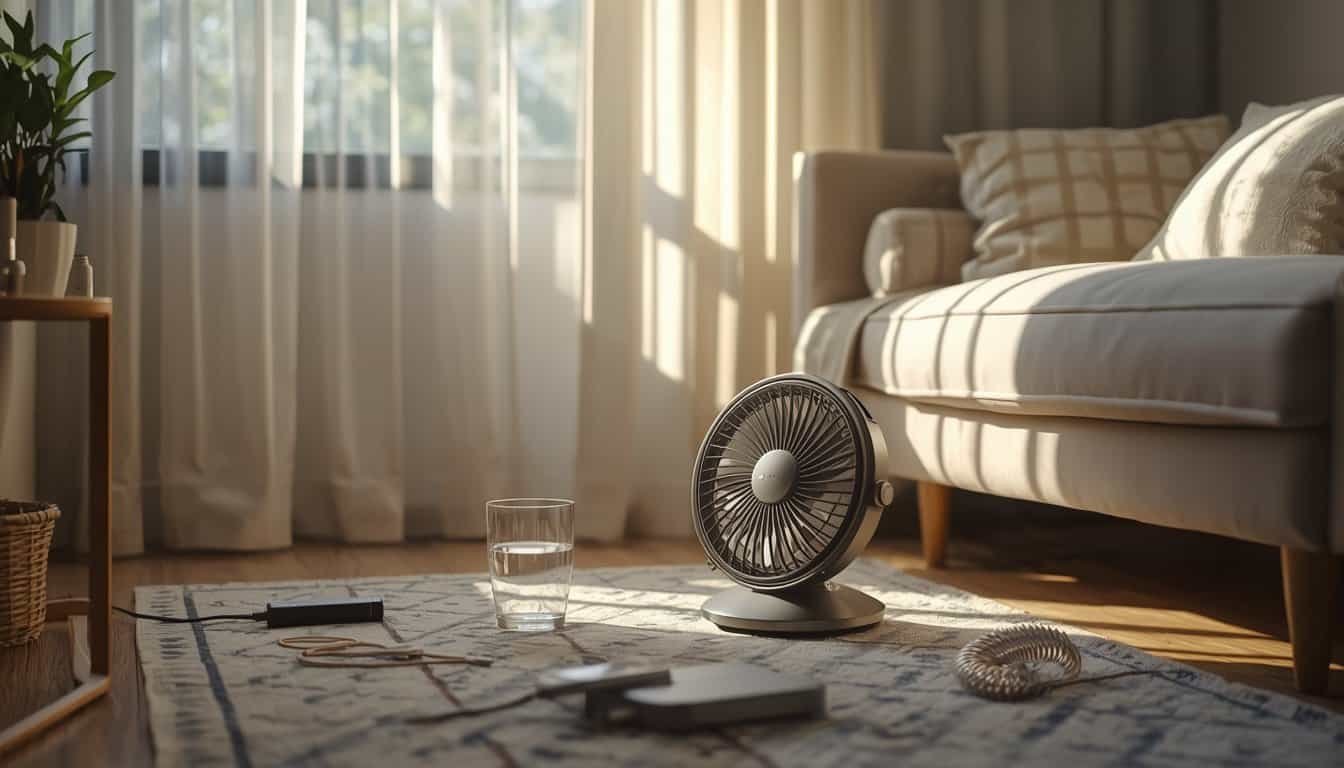
A portable fan can make a summer power outage more manageable, but it should be treated as a comfort and heat-safety support tool, not a guarantee that the home is safe. Fans move air across the skin; they do not remove heat from the room the way air conditioning does.
The best portable fan plan uses layers: a small rechargeable or battery fan for short outages, a larger fan connected to a portable power station for longer comfort, and a generator only when it can be used outdoors and safely. The plan should also include battery conservation, heat-risk limits, and a clear point when the household leaves for a cooler location instead of relying on fans.
Start With What a Fan Can and Cannot Do
A fan helps by moving air across your skin and improving evaporation when your body can still cool itself. That can make a room feel more tolerable, especially when people are hydrated, resting, wearing light clothing, and staying out of direct sun. A fan can also help move cooler evening air through the home if outdoor temperatures drop.
What a fan cannot do is lower the actual temperature of a closed hot room. If the room is already dangerously hot, blowing hot air across the body is not the same as cooling the air. That is why a fan plan should always be paired with shade, hydration, direct body cooling, and a relocation trigger.
If you need the broader room-cooling strategy first, start with How to Keep Your House Cool During a Power Outage Without AC. This article focuses specifically on choosing and using fan power options during an outage.
Use Small Battery Fans for the First Layer
A small battery-powered or rechargeable fan is the simplest first layer because it is portable, quiet, and easy to move toward the person who needs it most. It can be useful near a bed, chair, cooling zone, pet area, or medical-care area where direct airflow matters more than moving air through the whole house.
Choose a fan that can run on common batteries, USB power, or a built-in rechargeable battery that you can charge before storms. Built-in rechargeable fans are convenient, but they require discipline. If the fan is usually stored dead in a closet, it will not help when the outage begins.
Store the fan with its cable, charger, spare batteries if applicable, and a small note showing when it was last charged. If the fan uses replaceable batteries, keep the correct size in the emergency kit. If it uses USB, store a dedicated USB cable with it instead of borrowing the household’s only phone cord.
Use Power Banks for Personal Fans
Many small USB fans can run from a power bank. This can work well for short outages because the setup is simple: fan, cable, power bank, and a person who needs airflow. The key is making sure the power bank is reserved for safety priorities, not drained on entertainment devices before the hottest part of the day.
Match the fan to the power bank before an outage. Some fans draw very little power on low speed, while others drain a battery quickly on high. Test the fan at low and medium settings so you know whether it is a short comfort boost or an overnight helper.
Because phones, medical-alert devices, and communication tools may need the same backup battery supply, set priorities in advance. The Backup Charging Plan for Phones and Medical Alerts can help you decide what gets charged first when power banks are limited.
Use a Portable Power Station for Longer Fan Runtime
A portable power station can run larger fans for longer than a small power bank, depending on the fan’s wattage and the battery’s usable capacity. This can be useful for a cooling zone where one room becomes the household’s main resting area during a hot outage.
Before relying on this setup, check the fan’s wattage and test the combination. A small box fan on a low setting may be reasonable for some battery stations, while a large high-speed fan can drain the battery much faster. Fan speed matters because higher settings usually use more power and create more noise.
For rough planning, the Battery Backup Runtime Calculator can help estimate how long a battery may run a listed fan load. Treat the number as a planning estimate, not a guarantee. Real runtime depends on fan speed, inverter losses, battery age, temperature, and whether other devices are plugged in.
Use Fans to Cool People, Not Empty Rooms
During an outage, limited battery power should be aimed where it helps most. A fan blowing across an empty room wastes power. A fan aimed at a resting person, caregiver area, sleeping space, or shaded cooling zone can provide more practical benefit.
Position the fan close enough to feel the airflow without creating a trip hazard. Keep cords out of walkways, especially if older adults, children, pets, or people with mobility limits are moving through the area in low light. If the fan has a clip or stand, make sure it is stable before leaving it running.
Pair the fan with direct cooling. A damp cloth on the neck or wrists, light clothing, rest, and water nearby can make the airflow more helpful. If water service is available and safe, cool showers or baths may help reduce body heat more effectively than sitting in front of a fan alone.
Know When Fans Are Not Enough
Fans become less protective as indoor heat becomes extreme, especially for older adults, infants, people with chronic medical conditions, people taking certain medications, people with limited mobility, and anyone who cannot communicate symptoms clearly. A person can still develop heat illness even if a fan is running.
Watch for warning signs: dizziness, weakness, confusion, nausea, headache, fainting, hot skin, heavy sweating that changes, muscle cramps, or someone who cannot cool down after rest and fluids. If these signs appear, stop treating the fan as the solution and move toward cooling, medical help, or relocation.
For heat-specific escalation planning, review Heat Wave + Power Outage Planning. A fan plan should support the heat plan, not replace it.
Use Window and Ventilation Fans at the Right Time
Window fans and larger air-moving fans can help when outdoor air is cooler than indoor air. They are most useful in the evening, overnight, or early morning if the temperature outside drops enough to pull cooler air through the home. During the hottest part of the day, pulling hot outdoor air inside can make conditions worse.
If you use a window fan, think about direction. One fan may exhaust hot indoor air from an upstairs or sun-heated room, while another opening on the cooler side of the home allows replacement air to enter. This works best when outdoor air is actually cooler and the setup does not create security, rain, smoke, or air-quality problems.
Do not use a fan to pull smoky, polluted, humid, or extremely hot air into the home. Wildfire smoke, nearby generator exhaust, vehicle exhaust, and poor outdoor air quality can make ventilation unsafe even when the room feels stuffy.
Use a Generator Only With Outdoor Safety
A generator can run fans during a longer outage, but generator safety comes first. Generators must be operated outdoors and away from windows, doors, garages, vents, porches, and enclosed spaces. Never run a generator indoors, in a garage, or near openings just because the house is hot.
If a generator is already part of your outage plan, prioritize loads. A fan may be useful, but it may compete with a refrigerator, medical device, phone charging, sump pump, or other essential load. Do not overload the generator by trying to recreate normal power use during a heat outage.
Use heavy-duty outdoor-rated extension cords only as directed by the generator and appliance instructions, and keep cords away from standing water, door pinch points, and tripping areas. If the generator setup feels improvised or unsafe, a powered cooling location may be the better choice.
Build a Fan Kit Before Storm Season
A fan kit should be simple and easy to find. Include one or more battery fans, charging cables, spare batteries if needed, power banks, a larger battery station if you use one, a small flashlight, and written notes about which fan runs from which power source. Store the kit near your summer outage supplies rather than scattered around the house.
Before severe weather, charge every rechargeable fan and power bank. Test the fans at low speed and confirm the cables still work. If a fan has a built-in light, radio, or extra features, make sure those features do not accidentally drain the battery before the fan is needed.
Fan planning should fit into the larger household plan. Your 7-Day Power Outage Plan should include cooling, charging, food safety, water, medications, medical devices, pets, transportation, and where the household will go if the home stays too hot.
Choose the Right Fan for the Situation
Different fans solve different outage problems. A small personal fan is good for one person at close range. A clip-on fan may help near a bed, stroller, chair, or caregiver area. A box fan or pedestal fan can move more air in a cooling zone but usually needs more power. A window fan may help with ventilation when outdoor air is cooler.
For a household with older adults, medical needs, or accessibility concerns, simplicity may matter more than maximum airflow. A fan that is easy to charge, easy to carry, and easy to aim may be more useful than a powerful fan that is heavy, loud, or complicated.
Avoid buying a fan plan around best-case runtime claims alone. Look for practical questions: Can someone lift it? Is the cable included? Can it run while charging? Does it have a stable base? Can it run on low overnight? Can the household recharge it after the first day?
FAQ
Can a battery fan keep a room cool during a power outage?
A battery fan can improve comfort by moving air, but it does not lower the room temperature like air conditioning. Use it to cool people directly and leave for a cooler location if the home becomes dangerously hot.
How long will a portable power station run a fan?
Runtime depends on the battery capacity, fan wattage, fan speed, inverter losses, battery age, and other connected devices. A low fan setting usually lasts much longer than a high setting.
Is it safe to sleep with a battery fan running?
It can be reasonable if the fan is stable, cords are not a trip hazard, batteries are used according to instructions, and the room is not dangerously hot. Do not rely on a fan overnight if someone is showing heat-stress symptoms.
Can I run a fan from a generator?
Yes, if the generator is used outdoors and safely away from the home, and the fan is connected according to generator and cord instructions. Never bring a generator indoors or near windows, doors, garages, or vents.
Conclusion
Portable fans can be useful during a power outage, but they work best as part of a layered heat plan. Use small battery fans for short-term personal airflow, power banks for simple USB support, portable power stations for longer fan runtime, and generators only when they can be operated safely outdoors.
The most important rule is to treat fans as support, not proof that the home is safe. If heat keeps building, people cannot cool down, medical needs are at risk, or communication is failing, leave early for a cooler location or seek help before the outage becomes dangerous.