


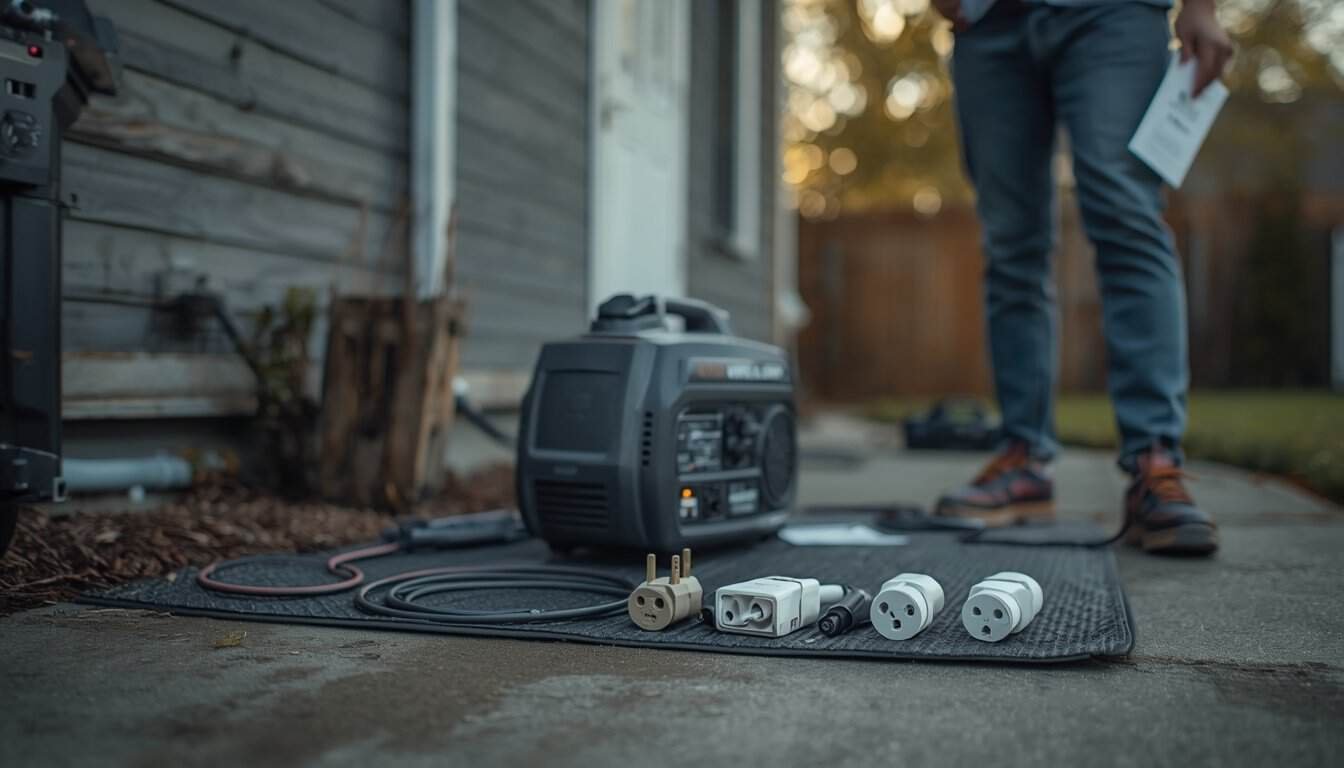
Generator outlet types can be confusing because the shapes, voltages, and amp ratings do not all mean the same thing. A standard household-style outlet, a 30-amp twist-lock outlet, a 120/240-volt outlet, and an RV-style outlet may all be on the same generator, but they are not interchangeable.
The safest way to understand generator outlets is to match four things before plugging anything in: voltage, amperage, plug shape, and the load you plan to power. The outlet tells you what the generator can provide at that connection, but the cord, appliance, transfer inlet, and generator capacity still have to match the setup.
Start With Voltage: 120V vs 240V
Many portable generators include 120-volt outlets for ordinary cord-connected loads. These are commonly used for items such as lights, phone chargers, small fans, some refrigerators, and other standard household plug-in equipment when the generator and cord are appropriate for the load.
Some generators also provide 240 volts or 120/240 volts. These outlets are usually intended for larger loads or for connection to approved transfer equipment that can feed selected home circuits. A 240-volt outlet does not mean you should plug in a random appliance. It means the generator has a connection capable of supplying that type of power when the rest of the setup is designed for it.
If you are unsure whether a problem is coming from the generator, cord, outlet, transfer equipment, or load, start with Generator Problems Explained. Outlet confusion often looks like a generator problem, but the real issue may be a mismatch between the outlet and what the homeowner is trying to power.
Understand Amps: 15A, 20A, 30A, and 50A
Amperage describes how much current an outlet, plug, cord, or circuit is designed to handle. A 15-amp or 20-amp receptacle is not the same as a 30-amp twist-lock outlet, and a 30-amp outlet is not the same as a 50-amp connection. The number matters because cords and loads must be matched to the rating.
A generator may advertise a large total wattage, but that does not mean every outlet on the generator can deliver the full amount. Each outlet has its own rating. The generator also has total running and starting capacity limits. You cannot safely pull unlimited power through one connection just because the generator has more watts available overall.
Look at the generator manual and the markings on the outlet area. If the outlet is rated for a certain amperage, the cord and connected equipment need to be appropriate for that rating. Do not use a small cord or adapter to pretend a lower-rated connection is larger than it is.
Standard Household-Style Generator Outlets
Many portable generators include standard household-style 120-volt outlets. These are the most familiar connections because ordinary plugs fit them. They are useful for small loads, basic lighting, phone charging, fans, and some appliances when the load is within the generator and outlet rating.
The familiar shape can create false confidence. Just because a plug fits does not mean the load is safe for the generator, cord, or outlet. A high-wattage appliance can overload a standard outlet or generator circuit, especially if other loads are connected at the same time.
Use these outlets for appropriate cord-connected loads only. Keep generator placement outdoors and use outdoor-rated cords. If the cord is long, thin, damaged, or warm, the outlet type is not the only problem.
Twist-Lock Outlets Explained
A twist-lock generator outlet uses a plug that inserts and then twists to help lock the connection in place. These are common on larger portable generators because they reduce the chance of accidental unplugging and can support higher-rated connections when used with the correct cord.
Twist-lock outlets come in different voltage and amperage configurations. A 120-volt 30-amp twist-lock is not the same as a 120/240-volt 30-amp twist-lock. The plug shape is designed so the wrong connector should not fit, but adapters and modified cords can defeat that protection if misused.
Do not assume that every twist-lock outlet is for a home inlet or transfer switch. Check the generator manual, transfer equipment instructions, plug configuration, voltage, amperage, and neutral requirements before using it for home backup.
RV-Style Outlets Are Not Automatically Home-Backup Outlets
Some generators include RV-style outlets, such as 30-amp or 50-amp connections intended for recreational vehicle use. These outlets can be useful for RVs when the generator and cord are matched correctly, but an RV outlet is not automatically the right way to power a house.
An RV-style outlet may have a different voltage, plug configuration, and intended use than a home transfer inlet. A plug that looks large and powerful does not make it suitable for house wiring. Home backup requires approved transfer equipment that prevents backfeeding and isolates utility power from generator power.
If you are trying to power selected house circuits, do not improvise from an RV outlet into a dryer outlet, wall outlet, or homemade adapter. Use the correct inlet, transfer switch, interlock, or professionally installed system for the generator and home.
Match Outlet Type to the Load
The outlet should match the load’s voltage, amperage, and plug design. A 120-volt appliance should not be connected to a 240-volt source. A high-demand appliance should not be forced through a low-rated cord or adapter. A hardwired home circuit should not be powered through an ordinary outlet.
Before storm season, list the loads you actually plan to power: refrigerator, freezer, sump pump, well pump, furnace blower, phone chargers, medical device, fan, lights, or transfer-switch circuits. Then compare that list with the generator’s outlet types and ratings.
For a rough planning check, use the Generator Sizing Calculator to estimate whether your intended loads fit within the generator’s capacity. Then confirm the outlet, cord, transfer equipment, and appliance requirements before treating the plan as ready.
Do Not Confuse Outlet Shape With Generator Capacity
A generator outlet shape tells you what kind of plug can connect there. It does not guarantee that the generator can run every appliance you attach. Capacity still depends on running watts, starting watts, outlet rating, cord rating, fuel type, generator condition, and what else is connected.
This is why a large outlet can still be part of an overloaded setup. If several high-demand loads start together, the generator may bog, trip, or produce weak power. If one load has a large motor startup surge, it may need more margin than the outlet shape suggests.
When in doubt, simplify the load. Start with one essential appliance or device, let it stabilize, and avoid stacking multiple motor or heating loads together unless the generator and wiring plan are built for that demand.
Cords Must Match the Outlet and the Job
The correct outlet still needs the correct cord. A heavy-duty 30-amp generator cord is different from a light household extension cord. A long cord run can create voltage drop. A damaged cord can create shock or fire risk. A cord with the wrong plug shape may tempt someone to use an unsafe adapter.
Use outdoor-rated cords with the correct plug, conductor size, amp rating, and length for the load. Keep cords dry, visible, and away from standing water, pinch points, sharp edges, and walking paths. Do not run cords under rugs or through doors in a way that damages insulation.
For a deeper cord-safety guide, use Extension Cord Sizing for Generators. Many generator outlet problems are really cord problems once the load moves away from the generator.
Transfer Inlets Are Different From Generator Outlets
A generator outlet is on the generator. A transfer inlet is usually mounted on the house and connects to approved transfer equipment. The inlet is not a normal outlet, and it should not be treated like one. Its job is to receive generator power through a proper cord and send it to selected circuits through a safe transfer method.
The generator outlet, generator cord, inlet box, transfer switch or interlock, breaker arrangement, and home circuits all need to match. If any part is mismatched, the system may fail to power the intended circuits, trip, behave unpredictably, or create unsafe conditions.
If the generator runs but the house does not receive power through the inlet or transfer setup, use Generator Runs but House Has No Power for safe external checks before assuming the outlet itself is the problem.
Neutral Bonding Can Affect Some Connections
Outlet type is not the only compatibility issue. Some generator setups also depend on whether the generator has a floating neutral or bonded neutral, especially when GFCI protection and transfer equipment are involved. A generator may trip or behave strangely if the neutral configuration does not match the transfer setup.
This is not something to solve with a homemade adapter or modified cord. If the generator trips GFCI protection when connected to the home, the problem may involve neutral bonding, transfer equipment design, moisture, a real fault, or a mismatch between generator and house connection.
For that issue, review Floating Neutral vs Bonded Neutral Generators. Neutral configuration is a safety and compatibility topic, not a plug-shape preference.
Why 120/240V Outlets Confuse Homeowners
A 120/240-volt generator outlet can supply both 120-volt and 240-volt power when used with the right equipment. That is why these outlets are common for transfer-switch connections. The connection can support selected home circuits that may include both legs of a split-phase system, depending on the transfer equipment.
The confusing part is that a 120/240 outlet is not a universal “whole house” outlet. The generator still has capacity limits. The transfer equipment still controls which circuits can be powered. A 240-volt capability does not mean every 240-volt load in the home should be run from the generator.
Large 240-volt loads such as electric ranges, electric dryers, central air conditioners, water heaters, and some well pumps may exceed what a portable generator can safely support. Check ratings before assuming the outlet makes the load practical.
Do Not Modify Plugs to Make Them Fit
Plug shapes are part of the safety design. If a plug does not fit an outlet, there is usually a reason. The voltage, amperage, grounding, locking style, or intended use may be different. Cutting, filing, rewiring, removing pins, or replacing plug ends casually can defeat those safeguards.
Modified plugs also create confusion later. Another person may assume the cord is standard and safe when it is not. During an outage, that kind of hidden modification can lead to shock risk, equipment damage, fire, or backfeeding.
If you need a different connection, buy the correct cord or have the system evaluated by a qualified professional. Do not turn a mismatch into a custom hazard.
Watch for Warning Signs After Connecting
Even when the outlet and cord appear to match, watch what happens after the load is connected. Warning signs include engine bogging, flickering lights, hot plugs, tripped breakers, burning smell, appliances that hum without starting, electronics that reset, or cords that feel warm.
These signs may mean overload, voltage drop, wrong cord size, failing equipment, poor regulation, moisture, or a load that is too large for the generator. Do not keep adding loads if the first load already makes the generator struggle.
Shut down or simplify the setup when warning signs appear. A correct-looking outlet does not make an unhappy generator safe.
Plan Outlet Use Before the Storm
The best time to understand generator outlets is before the power goes out. Read the generator manual, identify each outlet, write down voltage and amperage ratings, match each outlet to the correct cord, and list which loads are allowed on each connection.
Keep the outlet plan with the generator supplies. Include cord locations, transfer instructions, load priorities, fuel notes, and shutdown steps. If another family member may operate the generator, the plan should be plain enough to follow without guessing.
After each test run or outage, update the plan. If a load tripped a breaker, a cord got warm, or an outlet was confusing, fix that problem before the next storm instead of leaving it for another emergency.
FAQ
What are the most common generator outlet types?
Common generator outlet types include standard 120-volt household-style receptacles, 120-volt or 120/240-volt twist-lock outlets, and RV-style outlets on some models. The exact type depends on the generator.
Can I use an adapter on a generator outlet?
Only use adapters that are properly rated and specifically appropriate for the generator, cord, voltage, amperage, and load. Do not use homemade adapters or adapters that bypass grounding, neutral, GFCI, or transfer safety requirements.
What is a 30-amp twist-lock generator outlet for?
A 30-amp twist-lock outlet is commonly used for higher-rated generator cords and, on some generators, transfer inlet connections. The exact use depends on whether the outlet is 120 volts or 120/240 volts and what the generator manual allows.
Can I plug my generator into a dryer outlet?
No. Plugging a generator into a dryer outlet or wall outlet is unsafe and can cause backfeeding. Use approved transfer equipment and the correct inlet connection if you want to power home circuits.
Conclusion
Generator outlet types are easier to understand when you separate voltage, amperage, plug shape, and intended use. A standard 120-volt outlet, 30-amp twist-lock outlet, 120/240-volt connection, and RV-style outlet are not interchangeable just because adapters exist.
The safe plan is to match the outlet to the load, match the cord to the outlet, and match any home connection to approved transfer equipment. If the plug does not fit, the breaker trips, the cord gets warm, or the setup requires improvising, stop and correct the plan before the next outage.