


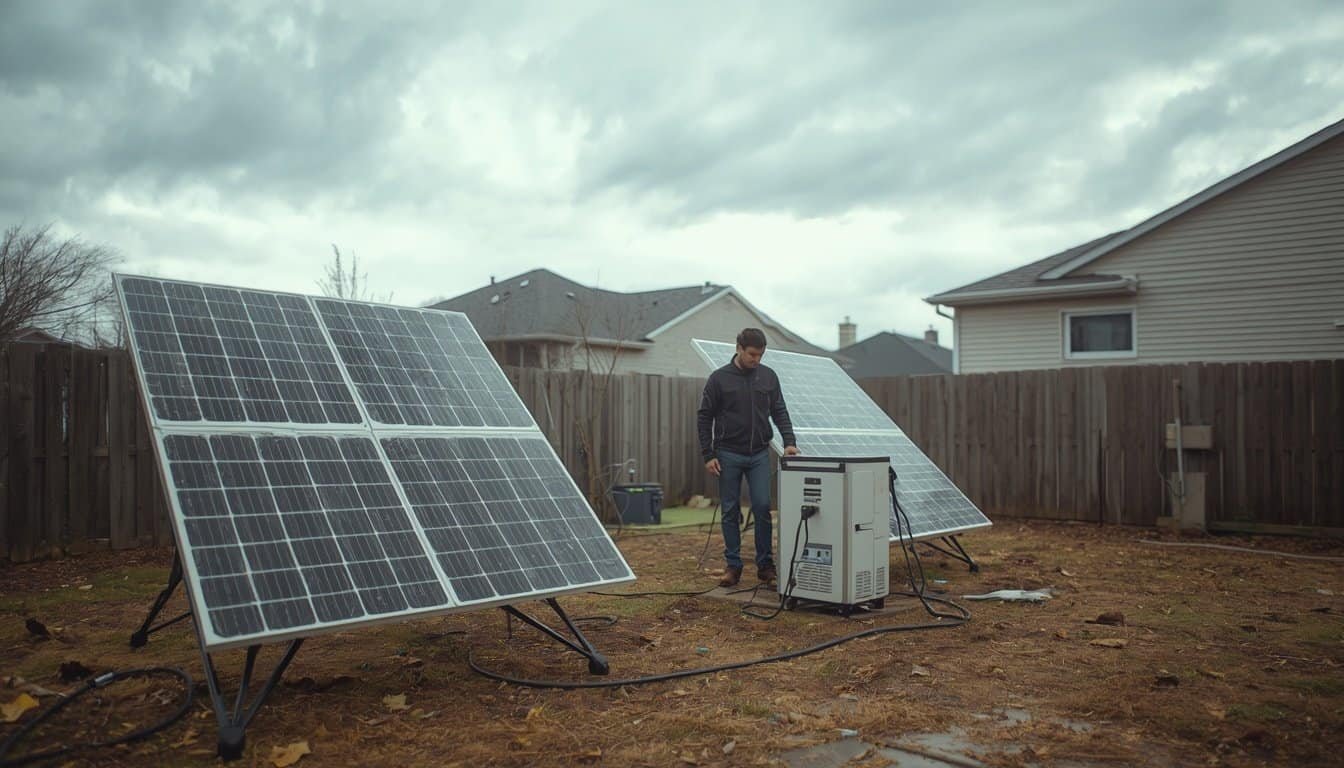
Portable solar panels can still charge a power station on cloudy days, but the amount of energy you collect may be far below the panel’s advertised wattage. During an outage, that difference matters because a battery that loses more energy overnight than the panels can replace the next day is gradually moving toward depletion even though the display still shows some solar input.
The safest way to plan is to treat cloudy-day solar as variable energy recovery rather than guaranteed full recharging. Watch how many watts the system is actually receiving, conserve battery power early, and be ready to switch to another charging source if the daily energy coming in cannot keep up with essential loads.
Why Cloudy-Day Solar Output Can Be So Different From the Panel Rating
A portable solar panel’s watt rating is a laboratory-style reference point, not a promise of what you will see every hour in your yard. Real output depends on the sunlight reaching the panel, panel temperature, angle, orientation, shading, cable losses, charge-controller limits, and the power station’s own charging behavior.
Cloud cover reduces the amount of direct sunlight striking the panel. Thin, bright clouds may still allow useful production, while thick storm clouds can cut output dramatically. Conditions can also change quickly as clouds move across the sky.
This is why a 200-watt panel should not be treated as a device that delivers 200 watts all day. During an outage, the number that matters is the actual energy collected over the usable daylight window.
Low Solar Input Is Not Automatically a Charging Failure
If your power station shows some solar input on a cloudy day, the system may be functioning normally even if the number looks disappointing. A panel producing a fraction of its rated output under heavy cloud cover is different from a system showing no input at all in good sun.
Before treating weak charging as a fault, look at the weather, time of day, panel orientation, and whether the panel has a clear view of the sky. If the system refuses to charge when conditions should be favorable, use our Solar Generator Not Charging guide for the troubleshooting path.
Panel Angle Still Matters Under Cloudy Skies
Cloudy light is more diffuse than strong direct sunlight, but panel position still matters. A panel lying flat, facing away from the brightest part of the sky, or partially shaded by a railing, tree, roof edge, or vehicle may collect less energy than a panel with a clearer exposure.
Use the panel stand or support method recommended by the manufacturer and keep the panel stable. Repositioning once or twice during the day can be worthwhile when the sun’s location is still visible through lighter cloud cover.
Do not create an unsafe setup just to chase a few extra watts. Avoid unstable roof placement, wet surfaces, traffic areas, or improvised supports that can fall onto the panel or cords.
Partial Shade Can Hurt More Than Homeowners Expect
A shadow from a tree branch, chimney, fence, vehicle, or part of the house can reduce useful output even when most of the panel still looks bright. The effect depends on the panel’s internal design, but portable panels generally perform best when the entire active surface has a clear view of the sky.
If output seems unusually low, move the panel out of obvious shade before assuming something is wrong with the charger. Our guide to Solar Panels Not Charging Batteries covers setup mistakes and charging problems in more detail when weather alone does not explain the result.
Watch Watt-Hours Recovered, Not Just the Highest Watt Number
A brief peak on the display can be encouraging, but outage planning depends on total energy collected over time. A system that reaches 150 watts for a few minutes and then spends most of the afternoon at 30 watts may recover much less energy than the peak number suggests.
Think in terms of the battery’s daily energy budget:
- How much battery energy did essential loads use overnight?
- How much solar energy was actually added during the day?
- Is the battery finishing each day at a higher, similar, or lower state of charge?
If the battery percentage is falling from one evening to the next, the system is running an energy deficit. Unless conditions improve or loads are reduced, the battery will eventually run out.
Use Cloudy Days to Prioritize Essential Loads
Weak solar input is a reason to simplify the outage plan early. Preserve stored energy for the equipment that matters most rather than waiting until the battery is nearly empty.
Common priorities may include phones, internet equipment, basic lighting, medical devices, a fan in hot weather, or short periods of refrigeration. High-draw convenience loads can consume hours of weak solar recovery in a very short time.
Our What Can a Solar Generator Power? guide can help separate realistic essential loads from equipment that may be impractical to support with a portable battery system during a prolonged outage.
Estimate Runtime Conservatively When the Forecast Stays Cloudy
Battery runtime calculations are most useful when you combine them with realistic charging assumptions. If the forecast calls for multiple cloudy days, do not assume the battery will return to 100 percent every afternoon.
Estimate how long your essential load can run from the battery you already have, then treat solar charging as energy that extends that runtime. The Battery Backup Runtime Calculator can help estimate the battery side of that plan. Use conservative load and efficiency assumptions rather than planning around ideal conditions.
Cloudy-Day Charging Can Still Be Valuable Even When It Is Slow
A slow recharge is not useless. If your essential loads consume 500 watt-hours in a day and cloudy solar recovers 300 watt-hours, the panels have still significantly extended the time before the battery is depleted.
The key is recognizing that the battery lost a net 200 watt-hours over that day. If the same pattern continues, you need to reduce consumption, collect more solar energy, or add another charging source before the battery gets too low.
Battery Size Does Not Fix a Solar-Energy Deficit Forever
A larger battery gives you more stored energy and more time, but it does not change how much sunlight the panels collect. If your daily loads consistently exceed your daily solar production, even a large battery will eventually discharge.
This is one reason solar-outage planning should consider both capacity and recharging. Our How Long Will a Solar Generator Run? guide explains how battery capacity, connected load, and recharging work together over a longer outage.
When to Add More Panel Capacity
If your power station accepts additional solar input and the manufacturer supports connecting more panel capacity, additional panels may improve energy collection during marginal conditions. But more panel wattage does not guarantee a full charge under heavy cloud cover.
The power station also has a maximum solar-input voltage, current, and wattage range. Do not exceed those limits or combine panels in configurations the manufacturer does not support.
Adding panels is a planning decision, not an emergency wiring experiment. Use compatible equipment and approved connection methods.
When a Generator or Other Charging Source Makes Sense
Solar is most useful when the available daylight can replace a meaningful portion of the energy you are using. If several cloudy days are forecast and the battery is steadily losing ground, another charging method may become necessary.
A generator can provide a predictable charging window when operated safely outdoors and when the power station accepts its output. Utility power, a compatible vehicle-charging method, or another manufacturer-approved source may also be options depending on the equipment.
Make the switch before the battery is nearly empty. Waiting until the last few percent of charge leaves less room for weather changes, equipment problems, or an essential load that suddenly needs more power.
Do Not Put Solar Equipment in Unsafe Weather Just to Keep Charging
Cloudy weather can turn into rain quickly. Portable solar panels and power stations have different weather-resistance ratings, and many battery power stations are not designed to sit in rain or standing water.
Follow the manufacturer’s weather guidance for both the panels and the battery unit. Keep plugs, adapters, extension connections, and the power station itself dry unless the equipment is specifically rated for the conditions.
Do not place the battery unit under a panel where runoff can drip onto it, wrap hot equipment in plastic, or create an enclosed cover that blocks ventilation.
A Practical Cloudy-Day Solar Routine
During a multi-day outage, a simple routine can help you see whether the system is keeping up:
- Check the battery level in the morning. Note how much energy was used overnight.
- Place the panels in the clearest available sky exposure. Avoid partial shade where possible.
- Watch actual solar input. Do not rely on the panel’s nameplate rating.
- Reduce high-draw loads during weak charging periods.
- Recheck panel position as the daylight changes.
- Compare the battery level near sunset with the previous evening.
- If the battery is losing ground each day, change the plan early.
- Protect equipment from rain, water, and unstable placement.
When Cloudy-Day Charging Is No Longer Enough
Switch to another backup strategy when essential loads are consuming more energy than the panels can replace, the battery is declining day after day, poor weather is expected to continue, or reducing loads further would compromise important household needs.
There is no benefit in waiting for the battery to reach zero before changing plans. Solar is one layer of outage resilience, not a guarantee that every load can continue indefinitely regardless of weather.
Cloudy-Day Solar Charging FAQ
Do solar panels work when it is cloudy?
Yes. Solar panels can still produce electricity under cloudy skies, but output may be substantially lower than under strong direct sunlight. The amount varies with cloud thickness, time of day, panel position, and other conditions.
Why is my 200-watt panel only producing a small fraction of 200 watts?
The nameplate rating is not a guaranteed real-world output. Cloud cover, panel angle, shading, temperature, cable losses, and the power station’s charging limits can all reduce the number shown on the display.
Should I keep using the battery normally if the panels are still charging?
Not necessarily. Watch whether the battery is actually recovering enough energy to replace what you use. If the charge level declines from day to day, reduce nonessential loads or prepare another charging source.
Can adding another solar panel solve cloudy-day charging?
It can improve collection if the power station supports the additional input, but heavy cloud cover can still limit total production. Never exceed the power station’s permitted solar-input specifications.
Bottom Line
Cloudy-day solar charging can be useful during an outage, but it should be planned around actual energy collected rather than the wattage printed on the panel. Thin clouds may still allow meaningful charging, while heavy overcast can reduce output enough that the battery never fully recovers.
Watch the battery trend from day to day, conserve essential energy early, keep panels clear of shade, and use the system’s real input reading to judge performance. If your household is using more energy than cloudy-day solar can replace, switch to another charging source before the battery becomes critically low.