


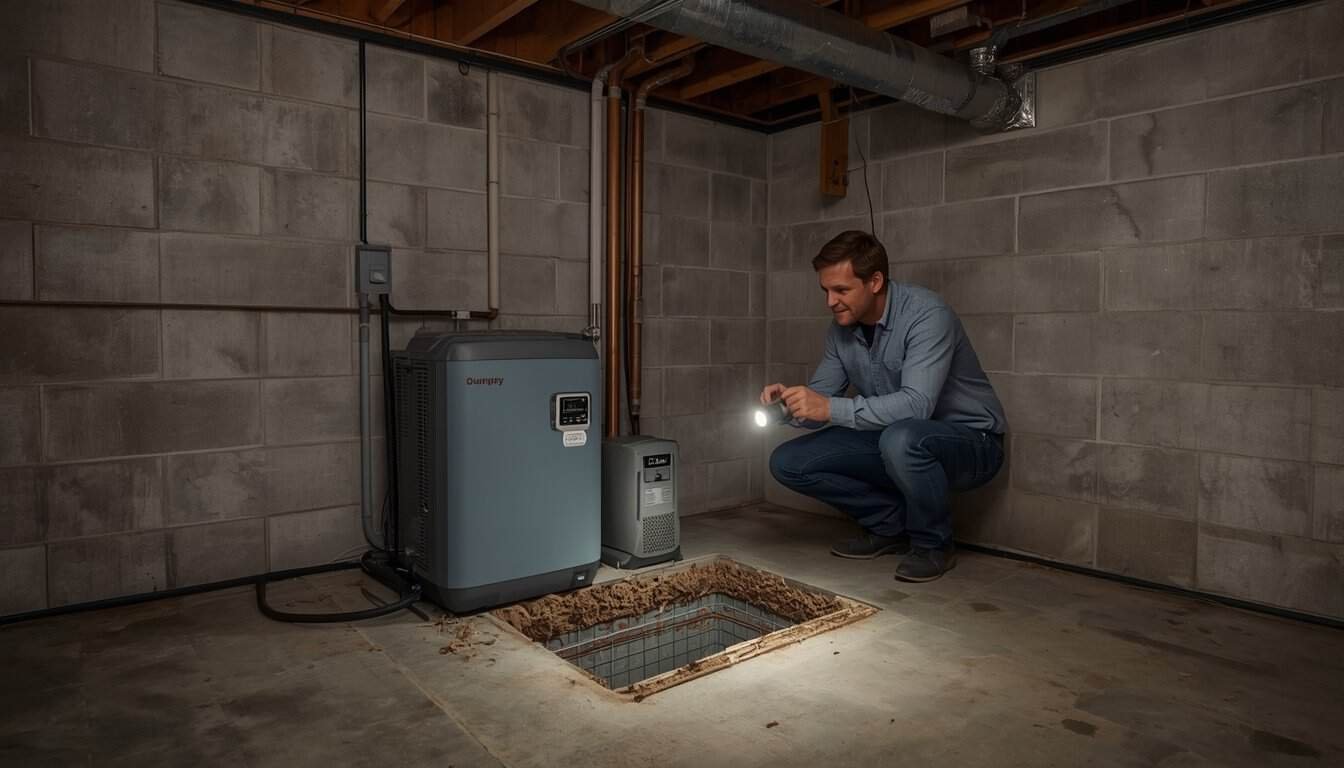
A sump pump battery backup can keep water moving during a power outage, but there is no single runtime number that applies to every home. The battery may last many hours when the pump cycles only occasionally, yet drain much faster during heavy rain or rising groundwater when the pump runs every few minutes.
The most important factor is not simply battery size. It is how often the backup pump has to run and how long each pumping cycle lasts. A quiet pit with occasional inflow uses relatively little energy. A pit that refills almost immediately after each cycle can turn the same battery into a short-duration emergency solution.
Why Sump Pump Battery Runtime Varies So Much
Sump pump backup systems are difficult to compare with simpler battery loads because the pump is not running continuously. It turns on when the water reaches a set level, pumps the pit down, shuts off, and waits for water to return.
That means two identical battery systems can have very different runtimes in two different basements. One home may see a pump cycle once every 30 minutes. Another may see the pit refill in two or three minutes during a major storm.
The second system is using far more battery energy even though the pump itself may be identical.
The Pump’s Cycling Frequency Is Usually the Biggest Runtime Variable
During an outage, pay attention to how often the backup pump turns on. The shorter the time between cycles, the faster the battery is likely to drain.
If the pump runs for 20 seconds every 20 minutes, the battery has long recovery periods between cycles. If it runs for 20 seconds every two minutes, the total daily run time becomes dramatically higher.
That is why a backup system that normally seems more than adequate can become marginal during prolonged heavy rain.
Heavy Rain and Rising Groundwater Can Change the Equation Quickly
Storm conditions can evolve during an outage. Rainfall may intensify, saturated soil may push more groundwater toward the foundation, or local drainage conditions may worsen.
A battery system that appears stable during the first hour may begin cycling much more frequently later. Treat increasing cycle frequency as an early warning that your remaining runtime is shrinking.
If your basement is already vulnerable to water intrusion, our What to Do If Your Basement Starts Flooding During a Power Outage guide covers the broader flood-risk picture and what to prioritize when the sump system is under stress.
Battery Age and Condition Matter
A battery does not necessarily deliver its original capacity forever. Age, deep discharges, storage conditions, charging history, corrosion, and time spent undercharged can all reduce usable capacity.
A battery that worked well during a short outage two years ago may not provide the same runtime today. If the backup battery is older or has been through several deep discharge events, assume less margin rather than more.
Do not rely on appearance alone. A battery can look normal externally and still have significantly reduced capacity.
Standby Time Is Not the Same as Pumping Time
Some backup systems can remain powered and waiting for a long time when the pump rarely activates. That does not mean they can pump continuously for the same length of time.
Think of standby time as the battery waiting for work. Active pumping is the expensive part. The more time the motor spends running, the faster the stored energy is consumed.
This is why manufacturer estimates should be interpreted carefully. If a runtime claim assumes a certain number of pumping cycles per hour, your actual result depends on whether your basement matches that assumption.
Use the Actual Pumping Pattern to Estimate Remaining Runtime
You do not need a perfect laboratory calculation to get a useful estimate. During an outage, observe a 15- to 30-minute window and note how often the backup pump runs and roughly how long each cycle lasts.
If the cycle pattern is steady, you can use that as a practical snapshot of how hard the battery is working. If the cycle rate is increasing, treat that as a sign that the system is under growing stress.
For a more useful sump-specific estimate, use the Sump Pump Backup Runtime Estimator. It lets you combine battery capacity, pump wattage, seconds per cycle, and cycles per hour to estimate runtime under current conditions and see how protection may shrink if the pump starts cycling more often.
Pump Startup Demand Also Matters
Like other motor-driven equipment, a sump pump can require more power when the motor first starts than while it is already running. That matters most if the backup setup uses an inverter or portable power station rather than a dedicated battery-backup pump system.
If an inverter-based backup repeatedly alarms or shuts down the moment the pump starts, the issue may be output capability rather than battery runtime. Our Power Station Overload Warning or Sudden Shutoff guide explains how startup surge and load limits can cause protective trips.
Repeated Short Cycling Can Consume Battery Capacity Quickly
If the sump pit refills almost immediately after each pump cycle, the battery can be consumed rapidly. Repeated short cycles may also indicate that inflow is simply exceeding what the backup plan was intended to handle for a long outage.
Do not assume that because the pump is still working, the plan is sustainable. A pump cycling constantly on battery power may have only a limited amount of protection time left.
When to Bring in Generator Support
If the outage is expected to last for many hours and the sump pump is cycling frequently, generator support may become the more sustainable option. A generator can either power the primary pump directly through an approved setup or recharge a battery system if the equipment manufacturer allows that arrangement.
The decision should be made before the backup battery is nearly depleted. Waiting until the battery is almost empty leaves little room for startup problems, fuel issues, weather complications, or connection delays.
If you are using a generator as part of the backup plan, follow safe outdoor operating practices and manage large loads carefully. Our Generator Load Rotation Plan explains how to prioritize essential loads when generator capacity is limited.
If the generator develops unstable power, repeated breaker trips, connection problems, or another symptom while you are relying on it to protect the basement, use the Generator Troubleshooting Hub to find the appropriate troubleshooting path without delaying your flood backup plan.
Do Not Count on a Single Battery During a Long Storm
For homes with a known water-intrusion problem, one battery should be treated as one layer of protection, not the entire flood plan. Long outages can outlast a battery even when the system is working perfectly.
A more resilient plan may include a healthy battery backup, generator support, an alternate pump, a water-powered backup where appropriate and allowed, or another professionally designed redundancy strategy.
The goal is not to operate every possible backup source at once. It is to make sure the failure of one layer does not immediately lead to basement flooding.
Watch for Signs the Battery Plan Is Failing
Several signs should push you toward the next backup layer sooner rather than later:
- The pump is cycling much more often than it did earlier in the outage.
- The battery indicator is dropping faster than expected.
- The system begins giving low-battery warnings.
- The pump sounds slower or takes longer to clear the pit.
- The water level rises higher between cycles.
- The backup system restarts, alarms, or faults repeatedly.
- Rainfall or groundwater conditions are still worsening.
Any one of these may mean the remaining runtime is becoming less predictable. Several at once should be treated as a strong signal to move to the next backup layer.
What Not to Do
Do not open battery cases, bypass alarms, connect random batteries, improvise battery wiring, or modify the sump pump’s electrical system during an outage. High-current battery circuits can create serious shock, heat, and fire hazards.
Do not place extension cords, chargers, inverters, or portable power stations where rising water could reach them. Electrical equipment and floodwater are a dangerous combination.
If water is already reaching electrical equipment, outlets, cords, or appliances, stop troubleshooting and treat the situation as an electrical safety problem.
A Practical Sump Pump Backup Checklist
During an outage, use this sequence:
- Confirm the backup pump is actually operating.
- Watch the pit level through several cycles.
- Time approximately how long each cycle lasts.
- Note how many times the pump runs per hour.
- Check the battery’s normal status indicators.
- Use the sump runtime estimate to understand your current protection window.
- Reduce unrelated battery loads if the system shares a power source.
- Prepare generator or alternate backup support before the battery is low.
- Recalculate if rainfall intensifies or cycle frequency increases.
- Stop if water approaches electrical equipment.
When to Switch Plans
Switch from battery-only operation when the pump is cycling frequently enough that remaining runtime is uncertain, the battery is showing low-charge warnings, the outage is expected to continue for many more hours, or conditions outside are still driving more water toward the foundation.
You do not need to wait for the battery to fail completely. In fact, waiting that long removes your safety margin.
If the backup pump itself is not keeping up with inflow, if water continues rising despite normal pump operation, or if the system faults repeatedly, move quickly to another flood-control strategy and qualified help.
Sump Pump Battery Backup Runtime FAQ
How many hours will a sump pump battery backup last?
There is no universal number. Runtime depends on battery capacity, battery condition, pump power, cycle length, and especially how often the pump cycles. A lightly used backup may last much longer than one running every few minutes during heavy rain.
How can I estimate my sump pump battery runtime more accurately?
Measure or estimate the pump’s running watts, how many seconds it runs per cycle, and how many cycles occur per hour. Those inputs give you a much more realistic estimate than relying on battery capacity alone, especially when pumping frequency changes during a storm.
Why is my sump pump battery draining so fast?
Frequent pump cycling is one of the most common reasons. Heavy water inflow, an aging battery, reduced battery capacity, additional battery loads, or a pump working harder than usual can all shorten runtime.
Can I recharge the backup battery with a generator?
Possibly, but only if the backup system and charger are designed to accept that charging method. Follow the equipment manufacturer’s instructions and keep the generator outdoors in a safe location.
Should I wait until the battery is almost dead before starting the generator?
No. If the outage is prolonged and the pump is cycling frequently, prepare the next backup layer early. Waiting until the battery is almost depleted leaves much less room for problems.
Bottom Line
Sump pump battery backup runtime is driven less by a single advertised number and more by real storm conditions. The biggest variable is how often the pump has to run. Light cycling may stretch a battery for many hours, while heavy inflow can drain the same system much faster.
Watch cycle frequency, battery condition, water level, and weather conditions together. Use the Sump Pump Backup Runtime Estimator to translate those real conditions into a practical planning estimate, then recalculate if the pump begins running more often. If the outage is likely to continue, move to the next backup layer before the battery is nearly empty.