


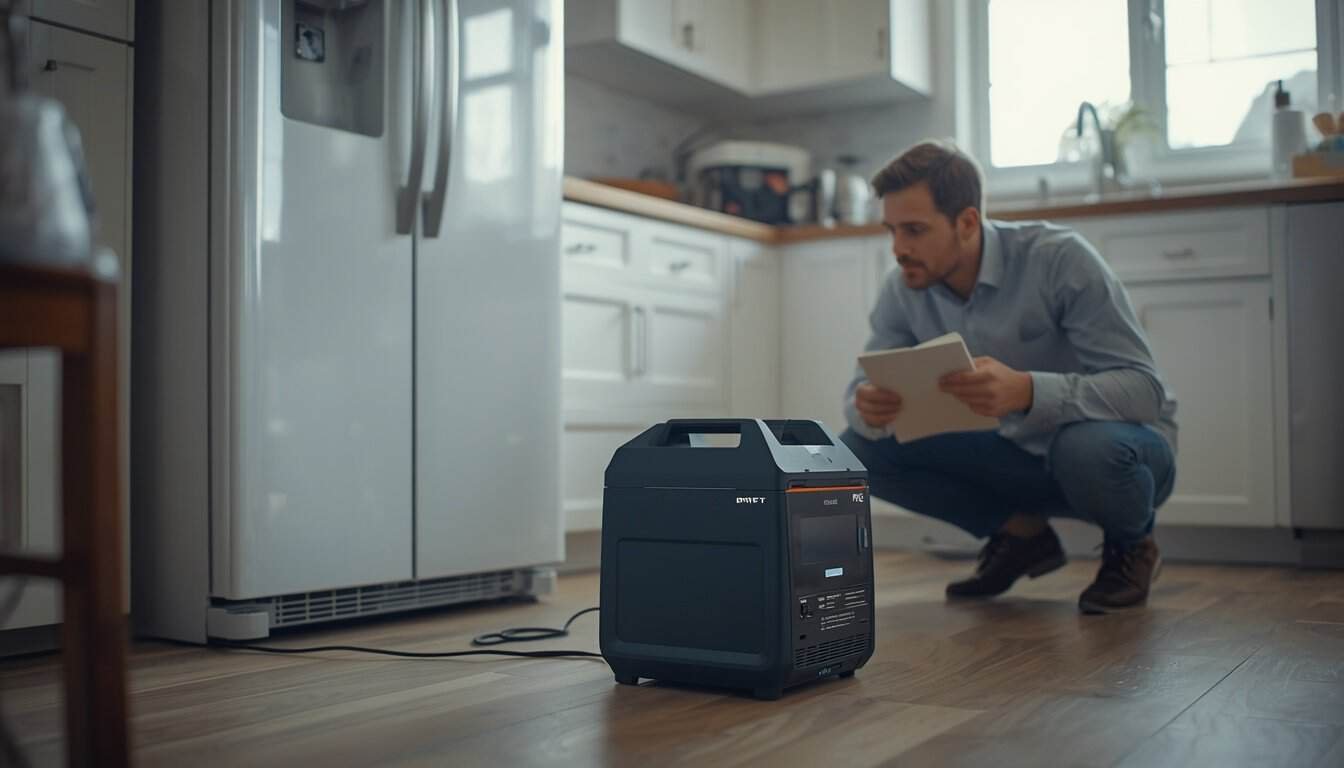
A portable power station may fail to run a refrigerator even when the refrigerator’s normal wattage appears to fit within the battery’s capacity. The most common reason is startup surge: the refrigerator compressor can demand much more power for a brief moment when it starts than it uses while running.
Other causes include the power station’s AC inverter limit, a low state of charge, cold or overheated battery conditions, an undersized extension cord, or additional refrigerator loads such as a defrost heater or ice maker. The safest troubleshooting approach is to separate “Can the power station start the refrigerator?” from “How long can the battery run it?” because those are two different problems.
Why a Refrigerator Can Overload a Power Station at Startup
A refrigerator does not draw the same amount of power every second. When the compressor is already running, its electrical demand may be relatively modest. When the compressor first starts, however, the motor can briefly require substantially more power.
That momentary demand is commonly called startup surge, starting watts, or inrush current. If the refrigerator asks for more than the power station’s inverter can provide, the power station may beep, display an overload warning, shut off its AC outlets, or repeatedly attempt to restart.
This is why comparing only the refrigerator’s running-watt number with the power station’s battery capacity can be misleading. The battery may hold plenty of energy, but the inverter still has to deliver the required power at the instant the compressor starts.
Battery Capacity and Inverter Output Are Not the Same Thing
A power station has two specifications that matter here: energy capacity and AC output capability. Energy capacity is normally expressed in watt-hours (Wh). AC output is normally expressed in watts (W), often with both a continuous-output rating and a short-duration surge rating.
Think of watt-hours as the size of the fuel tank and output watts as the size of the engine. Increasing the size of the “tank” does not automatically increase the amount of power that can be delivered at one instant.
If your main problem is that the refrigerator starts normally but the battery empties much faster than expected, that is a different troubleshooting lane. Our guide to why a power station drains too fast explains runtime, load, and battery-limit problems in more detail.
What to Check When the Refrigerator Will Not Start
Start with simple observations rather than repeated restart attempts. The goal is to identify whether the problem is overload, battery condition, connection loss, or something inside the refrigerator that requires professional service.
1. Disconnect Other Loads From the Power Station
Run the refrigerator as the only meaningful AC load during the test. A microwave, coffee maker, fan, television, charger, or other appliance may seem small by itself, but combined loads can leave too little headroom for compressor startup.
If the refrigerator starts when other loads are removed, the issue is probably not battery capacity alone. It is more likely that the combined instantaneous demand exceeded the power station’s available output.
2. Check the Power Station’s Continuous and Surge Ratings
Review the power station manufacturer’s specifications for continuous AC output and surge output. Then compare those limits with the refrigerator manufacturer’s electrical information if available.
Do not assume modest running wattage means modest startup demand. If the specifications are unclear, check manufacturer compatibility guidance rather than guessing.
3. Start With a Well-Charged Power Station
A refrigerator that starts with a nearly full power station may behave differently when the battery is deeply discharged or temperature protection is active. Recharge a nearly empty unit before judging compatibility. If the power station itself will not accept a charge, troubleshoot the charging problem separately rather than continuing to cycle the refrigerator.
4. Remove Unnecessary Extension-Cord Losses
If practical and allowed by the equipment instructions, test with the refrigerator connected directly to the power station’s appropriate AC receptacle. Long or undersized extension cords can introduce voltage drop and make motor startup more difficult.
If an extension cord is necessary, use a properly rated grounded cord suitable for the appliance load and the environment. Do not daisy-chain cords, use damaged plugs, or route cords through water, pinched doorways, or places where they can overheat unnoticed.
5. Give the Refrigerator Time Before Restarting It
Rapidly switching a refrigerator off and back on can make compressor restart more difficult because pressure may not yet have equalized inside the refrigeration system. If the refrigerator has just stopped, follow its manufacturer guidance before attempting another startup.
Repeatedly forcing restart attempts is not a useful diagnostic method. If the power station trips every time the compressor tries to start, stop and reassess the output requirement.
Why the Refrigerator May Start but Shut Off Later
A successful first startup does not prove the entire outage setup is adequate. Refrigerators cycle on and off, and some models periodically activate additional loads. A power station that seems fine for an hour may later shut down when the compressor restarts, a defrost cycle begins, or another device is added to the battery.
Battery state also changes over time. As stored energy falls, a marginal setup can become less tolerant of startup demand. High internal temperature or poor ventilation around the power station can also trigger protective shutdowns.
Watch the pattern. If the power station shuts down only when the refrigerator compressor starts, suspect output or surge limitations. If it runs normally for many hours and then reaches a low-battery shutdown, the problem is primarily runtime. The Battery Backup Runtime Calculator can help estimate how battery capacity and load affect expected operating time.
Do Not Confuse Refrigerator Watts With Daily Energy Use
A refrigerator cycles rather than running continuously, so outage planning is more complicated than multiplying one wattage number by 24 hours. Room temperature, door openings, food load, defrost operation, and compressor cycling can all change energy use. Use measured consumption when available and leave a margin for conversion losses and changing conditions.
When a Power Station Is the Wrong Tool for the Refrigerator
A power station is not automatically a good refrigerator backup just because both devices have standard household plugs. If the refrigerator repeatedly exceeds the inverter’s startup capability, the safer answer is usually a different power source or a power station with appropriate output specifications—not repeated overload attempts.
Some households use a generator for larger or longer-duration loads, while others reserve the power station for smaller essentials. Our Portable Power Station vs Generator guide explains those tradeoffs.
Safe Alternatives If the Refrigerator Will Not Run
If the refrigerator cannot be powered reliably, shift from troubleshooting to preservation planning. Keep refrigerator and freezer doors closed as much as possible, move critical items only when you have a better storage location ready, and use coolers or other approved cold-storage methods when appropriate.
If you have another backup source, compare its capabilities before transferring the refrigerator. A generator may be suitable when it is correctly sized, operated outdoors, and connected safely. Our guide to running a refrigerator on a generator during an outage covers that separate setup.
Food safety should not depend on whether the refrigerator “feels cool.” When an outage lasts long enough to threaten refrigerated food, follow established food-safety guidance. Power Prep Guide’s Food Safety During Outages guide covers refrigerator and freezer decision-making separately.
A Safe Troubleshooting Sequence
If your power station will not run the refrigerator, use this order:
- Stop repeated overload attempts. Let the refrigerator and power station settle.
- Disconnect other loads. Give the refrigerator the available AC output by itself.
- Confirm the power station is adequately charged.
- Check continuous and surge-output specifications.
- Eliminate unnecessary cord length or undersized cords.
- Try one controlled restart if the equipment instructions allow it.
- Observe what happens. Instant overload points toward startup/output limits; a much later shutdown points more toward runtime.
- Stop if the setup remains unreliable. Move to another backup plan rather than defeating protective features.
When to Stop Troubleshooting
Stop using the setup if the power station, plug, receptacle, or cord becomes unusually hot; you smell burning; the unit repeatedly trips or shuts down; the battery enclosure looks swollen or damaged; moisture is present around electrical equipment; or the refrigerator makes abnormal mechanical or electrical sounds.
Also stop if diagnosing the problem would require opening the refrigerator, removing electrical covers, modifying a cord, or bypassing a protective device. Those steps move beyond safe homeowner troubleshooting.
Power Station and Refrigerator FAQ
Can a 1,000-watt power station run a refrigerator?
Possibly, but the watt rating alone is not enough to answer the question. The power station must handle the refrigerator’s compressor startup surge as well as its normal running load, and the battery must hold enough energy for the desired runtime.
Why does my refrigerator run for a while and then trip the power station?
The refrigerator may be entering another compressor cycle or activating an additional load such as defrost. The power station may also be at a lower state of charge or a higher temperature than it was during the first startup.
Does a bigger battery always solve the problem?
No. More watt-hours can increase potential runtime, but they do not automatically increase inverter output. If startup surge exceeds the inverter limit, additional battery capacity alone may not help.
Should I keep trying if the power station shows an overload warning?
No. Remove loads and verify the equipment requirements before trying again. Repeated overload attempts do not increase compatibility and may leave you without backup power for other essential devices.
Bottom Line
When a power station will not run a refrigerator, the first question is usually not battery size—it is whether the inverter can handle compressor startup. Once the refrigerator can start reliably, battery capacity, cycling behavior, efficiency losses, and outage conditions determine how long the setup may last.
Troubleshoot by removing other loads, checking output limits, starting with a charged battery, minimizing cord losses, and watching exactly when the shutdown occurs. If the combination repeatedly overloads or behaves abnormally, use another backup plan instead of bypassing the protections built into either device.